

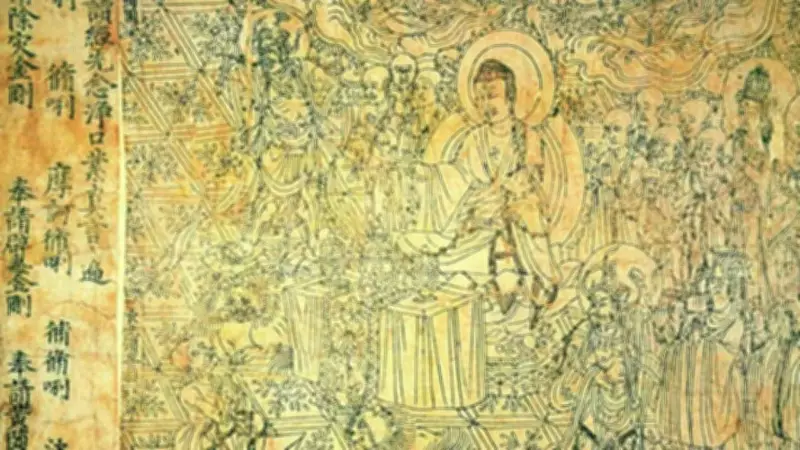
On May 11, 868 C.E., a remarkable event occurred in China that revolutionized historians' understanding of printing history. The Buddhist scripture known as the Diamond Sutra was printed and disseminated by a man named Wang Jie. While it may have been perceived as a religious practice at the time, it later became one of the most critical achievements in human history.
What Makes the Diamond Sutra Unique
The Diamond Sutra is unique not only for its age but also for its preservation. This scroll dates back over 1,100 years and was eventually buried in a cave in northwest China. Years passed until researchers discovered it, realizing they had found the oldest surviving complete printed book with a definite publication date.
In addition to being a religious artifact, it provides insight into the level of development in China during the Tang dynasty. The Diamond Sutra also demonstrates that printing techniques were highly advanced before Johannes Gutenberg invented the printing press in Europe.

How the World's Oldest Printed Book Survived for Over a Thousand Years
Woodblock printing was used to create the Diamond Sutra. This innovation was already prevalent in China during the 9th century. Unlike movable type printing, introduced many centuries later, woodblock printing required craftsmen to carve an entire page of writing and illustrations onto a wooden board.
Every stroke had to be carefully engraved backwards. After engraving, the board was inked, and sheets of paper were applied to produce printed pages. The pages were then sewn together into a continuous scroll measuring about sixteen feet in length. A single error during engraving rendered the whole board useless, requiring the craftsmen to start over. Nevertheless, this technique enabled religious writings to be duplicated more swiftly than by hand-copying.
The Sacred Artwork and the Hidden Cave That Protected the Diamond Sutra
The document includes images of Buddha at the start, indicating the close relationship between Buddhism and art in Tang China. The colophon written by Wang Jie at the end provides information on the document's purpose and documents the exact printing date. This information is important to historians as it pinpoints the actual date of creation.
The Diamond Sutra, along with thousands of documents, was housed in a secret cave near Dunhuang, northwestern China, before the year 1000 C.E. The cave, part of the Mogao Caves, is located along the Silk Road and includes hundreds of caves hewn from stone cliffs. One chamber, later called Cave 17 or the Library Cave, was sealed and remained untouched for nearly nine hundred years. Historians are still uncertain why the cave was closed, though some believe the manuscripts were hidden for protection during periods of unrest.
The Hidden Cave Discovery That Revealed the World's Oldest Printed Book
Wang Yuanlu, a Taoist monk, discovered the Library Cave while conducting restoration activities around 1900. It contained several thousand manuscripts, paintings, and religious books that had been kept there for centuries. The discovery became known to foreign archaeologists and explorers traveling across central Asia. For instance, Aurel Stein, a Hungarian-British explorer, investigated the manuscripts and ended up taking most of the books, including the Diamond Sutra, to England, where they now reside in the British Library.
Enduring Significance of the Diamond Sutra in World History
The Diamond Sutra is not just an old religious document. It marks a major milestone in the evolution of communication and knowledge transfer. Long before the invention of modern books, newspapers, and online publications, people had discovered techniques to copy and disseminate information on a mass scale. The preservation of the document for over a thousand years is equally impressive. From its discovery in the Dunhuang caves, the scroll has traversed several phases of human civilization without suffering significant damage.

About the Author: TOI World Desk - At TOI World Desk, our dedicated team of seasoned journalists and passionate writers tirelessly sifts through the vast tapestry of global events to bring you the latest news and diverse perspectives round the clock. With an unwavering commitment to accuracy, depth, and timeliness, we strive to keep you informed about the ever-evolving world, delivering a nuanced understanding of international affairs to our readers. Join us on a journey across continents as we unravel the stories that shape our interconnected world.





