

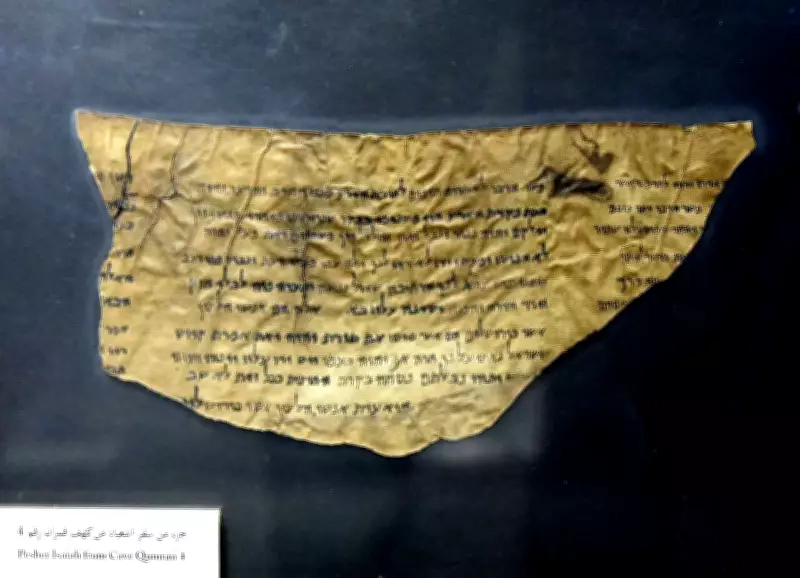
In 1947, a young shepherd in the Judean Desert, searching for a lost goat, threw a pebble into a crevice of limestone caves near Qumran. Instead of a dull thud, he heard the sound of shattering pottery. Curiosity led him and his companions into the cave, where they found glass tubes containing linen-wrapped packets of old paper. Unbeknownst to them, these were the Dead Sea Scrolls, a secret library hidden for nearly two thousand years. This chance event became one of the greatest archaeological discoveries of the age.
A Library That Survived Time
Over the next decade, researchers explored the area and discovered eleven caves filled with fragments. These were not random notes but an archive. According to the Library of Congress, every book of the Hebrew Bible except the Book of Esther was represented. The scrolls date back ten centuries earlier than any other extant Hebrew biblical scriptures, providing a remarkable time jump that allowed researchers to trace the preservation of these texts over centuries. They demonstrated that the biblical text remained remarkably constant over a thousand years, an incredible discovery for scholars and believers alike. The documents also included community rules, hymns, and sectarian works, revealing the diversity of Jewish society at the time.
Preserving the Ancient Religion: A Science of Survival
The preservation of these delicate artifacts was a miracle of natural conditions and human effort. The pots found by the shepherd were specially crafted for storage. According to a study in Science Advances, the scrolls required elaborate preparation and storage. The desert conditions at the Dead Sea provided a vault-like environment, while ancient people took specific steps to preserve the parchments. Thanks to these practices, we have a window into the world from the third century B.C.E. to 68 C.E., a period of change and transition. The Dead Sea Scrolls are proof of political and ideological transformations, serving as an irreplaceable source for tracing the roots of Jewish and Christian beliefs. They show that history is not just a series of dates but a struggle for self-preservation and identity.

Today, the Dead Sea Scrolls are housed in the Shrine of the Book in Jerusalem, with ongoing research by scholars worldwide. They illustrate how one stone thrown into the dark can illuminate an entire world. The young shepherd was merely searching for a sheep but found the foundation for a shared human legacy.






