

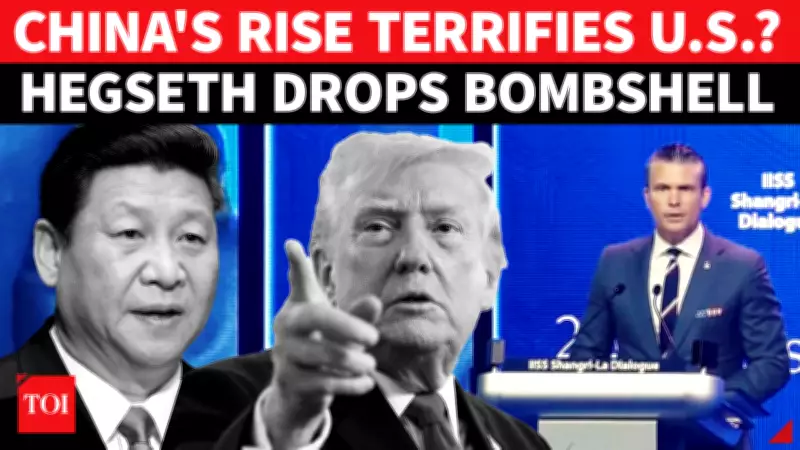
A sharp warning from U.S. Defense Secretary Pete Hegseth has put the spotlight on rising tensions in the Indo-Pacific. Speaking at the prestigious Shangri-La Dialogue in Singapore, Hegseth urged Asian allies to significantly boost defense spending and strengthen their military capabilities to counter China's growing influence and expanding military presence.
Warning of "rightful alarm" over Beijing's rapid military buildup, Hegseth said the United States wants allies that are stronger, more self-reliant, and better prepared to deter potential aggression. He cautioned that a Pacific region dominated by a single power would undermine the balance of power that has helped maintain stability for decades.
The remarks come amid increasing geopolitical competition between the United States and China, with concerns mounting over security in the South China Sea, Taiwan Strait, and the broader Indo-Pacific region. Hegseth's comments have sparked alarm across U.S. allies in the region, who are now reassessing their own defense postures.

The Shangri-La Dialogue, an annual security summit organized by the International Institute for Strategic Studies, serves as a platform for defense leaders to discuss key security challenges in the Asia-Pacific. This year's meeting has been dominated by discussions on China's military expansion and the need for a collective response.
Hegseth emphasized that the United States remains committed to its alliances in the region but expects its partners to take greater responsibility for their own defense. He called for increased investment in modern military equipment, cyber capabilities, and joint training exercises to ensure a credible deterrent against any potential aggression.
Analysts say the warning reflects growing frustration in Washington over the slow pace of military modernization among some Asian allies. The United States has long urged countries like Japan, South Korea, and Australia to boost their defense budgets and enhance interoperability with U.S. forces.
China has yet to officially respond to Hegseth's remarks, but Beijing has consistently rejected accusations of aggressive expansion, insisting that its military development is defensive in nature. However, its assertive actions in the South China Sea and increased military activity around Taiwan have heightened concerns among regional nations.
The timing of Hegseth's speech is significant, coming just weeks after a series of incidents involving Chinese naval vessels in disputed waters. The U.S. has also been pushing for closer security cooperation with allies like the Philippines, which faces ongoing tensions with China over territorial claims.
As the geopolitical landscape continues to shift, Hegseth's warning underscores the urgency for Asian allies to strengthen their defense capabilities. The coming months are likely to see increased diplomatic and military activities as both the United States and China vie for influence in the region.






