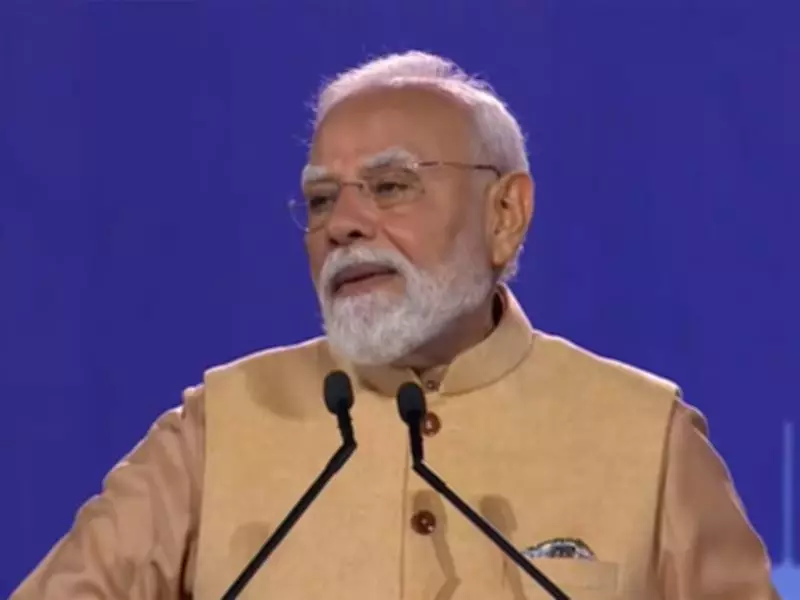
Prime Minister Narendra Modi, addressing the Indian diaspora in Melbourne on July 9, 2026, declared that India is not resting on the success of the Chandrayaan mission and is forging ahead with ambitious space programs, including the Gaganyaan human spaceflight mission and the development of its own space station. Speaking at the "Melbourne Meets Modi" event during his three-day official visit to Australia, Modi highlighted that India's space achievements reflect a belief in continuous progress driven by the motto "Grow More, Achieve More."
Chandrayaan Success and Future Ambitions
Modi noted that India successfully landed Chandrayaan on the Moon's south pole, a feat no other country has accomplished. "But India was not satisfied with only this achievement," he said. "Because India believes - Grow More, Achieve More. That is why India is now preparing to send its Gaganyaan mission into space. India is also moving towards the goal of building its own space station."
The Gaganyaan mission aims to send Indian astronauts into space, marking a major milestone for the Indian Space Research Organisation (ISRO). The planned space station, expected to be operational by 2035, will enable long-duration microgravity experiments and bolster India's presence in space.

Innovation and Startup Ecosystem
Modi also underscored India's transformation of its innovation ecosystem, learning from global advancements. He praised Australia's contributions, including cochlear implants, Wi-Fi technology, cervical cancer vaccines, flight black boxes, and secret ballot voting. "These innovations are making the world better. In the same way, India is also transforming its science, technology and innovation ecosystem," he added.
He highlighted the Atal Tinkering Labs initiative, which fosters scientific thinking among young students. "Today more than 10,000 Atal Tinkering Labs are operating in Indian schools. These labs are building a mindset of innovation among students from an early age," Modi said. He also noted that India has become the world's third-largest startup ecosystem in the last 12 years.
Private Sector Participation in Space
Modi pointed to the growth of India's startup landscape, with more than 2 lakh registered startups and over 4,000 new startups being registered every month. "Hundreds of startups are also working in sectors like defence and space," he said. He emphasized that sectors previously closed to private entrepreneurship, such as defence and space, have now opened up. "One Indian space startup is soon going to launch a satellite using its own rocket for the first time," he announced.
This reference aligns with Skyroot Aerospace's upcoming test flight of its Vikram-1 orbital rocket, named Mission Aagaman. The company announced that the mission is scheduled to launch from the Satish Dhawan Space Centre between July 12 and August 4, 2026. The Vikram-1 test flight aims to place a payload into a 450 km Low Earth Orbit (LEO) with a 60-degree inclination. Skyroot confirmed that the vehicle has been fully stacked at India's First Launch Pad (FLP).
India-Australia Partnership
Modi's remarks came as he addressed an estimated 30,000 people at the event, described as perhaps the largest gathering for any leader in Australia. Earlier, he concluded a high-level summit with Australian Prime Minister Anthony Albanese in Melbourne, marking a significant expansion of the Comprehensive Strategic Partnership (CSP). The visit, from July 8 to July 10, resulted in 18 major outcomes spanning defence, maritime security, energy, critical technologies, education, mining, research, and cultural cooperation.