

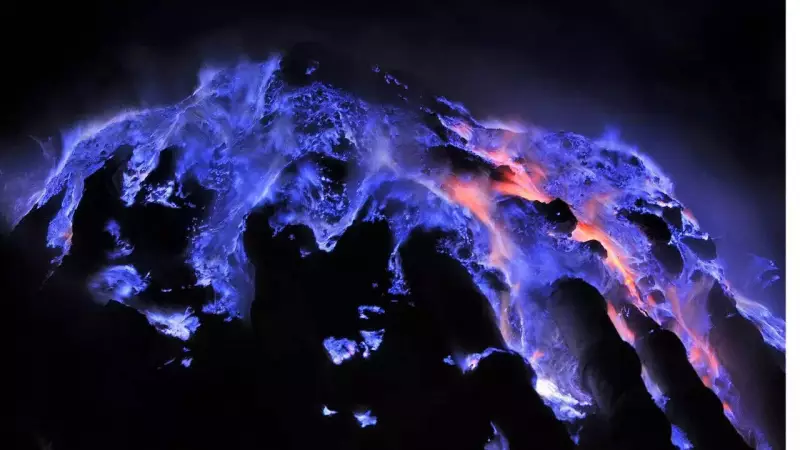
In the heart of Indonesia, a volcano presents a spectacle that seems to defy the very laws of nature. While most volcanoes are known for their rivers of red-hot lava, the Kawah Ijen volcano on Java island captivates the world with a different, more ethereal display: dancing electric blue flames that illuminate the night sky. This surreal phenomenon has turned the crater into a magnet for intrepid travellers, photographers, and geologists seeking to witness one of Earth's most visually stunning geological processes.
The Science Behind the Neon Blue Inferno
Contrary to popular belief and dramatic photographs, this mesmerizing blue glow is not molten lava. The phenomenon is a spectacular chemical reaction. Sulfuric gases, seeping from fissures in the crater at extreme temperatures exceeding 600°C (1,112°F), ignite upon contact with the oxygen in the air. This combustion produces a vivid, neon-blue flame that can appear to flow like lava, especially in long-exposure photography, earning it the nickname "blue lava."
This process is part of a rare event known as a Cerulean eruption, where the burning sulfur condenses into a liquid state and cascades down the volcanic slopes, creating rivers of blue light. According to reports from ZME Science, such events are exceptionally rare, occurring in only a handful of locations globally, including the Danakil Depression in Ethiopia. For those who capture it, the scene feels less like a landscape on Earth and more like a frame from a science fiction film.

The Human Cost: Mining 'Devil's Gold' in a Toxic Hellscape
The breathtaking beauty of Kawah Ijen's blue flames casts a stark shadow on a harsh human reality. The same crater is a source of livelihood for local sulfur miners, who brave perilous conditions daily. These men venture into the toxic, smoke-choked environment of the crater with minimal protection, often using only damp cloths as masks against the choking sulfuric fumes.
Their mission is to extract solidified sulfur, a valuable industrial material crucial for making fertilizers, matches, and chemicals. This sulfur is locally nicknamed 'Devil's Gold' for its worth and the hellish conditions required to obtain it. Once the sulfur hardens into bright yellow chunks, miners manually break it loose and carry it out in heavy wicker baskets, often weighing 70-90 kilograms, up the steep and treacherous crater walls. It is a back-breaking and hazardous endeavour that underlines the extreme lengths humans go to for survival.
A Natural Laboratory for Global Science
Beyond its visual appeal and human drama, Kawah Ijen serves as a crucial open-air laboratory for scientists. The unique confluence of factors—magma, water, and high-pressure sulfuric gases—provides invaluable insights into volcanic gas emissions and subsurface chemical reactions. Studying this environment helps researchers better understand the risks such volcanoes pose to human health and the surrounding ecosystem.
Kawah Ijen stands as a powerful testament to where natural wonder, scientific inquiry, and human resilience intersect at the edge of danger. It reminds us that our planet's most awe-inspiring sights are often born from intense geological forces and are frequently intertwined with profound human stories of endurance.






