Iran US Deal: Ghalibaf Warns US of 'Crushing Response' Over Breach
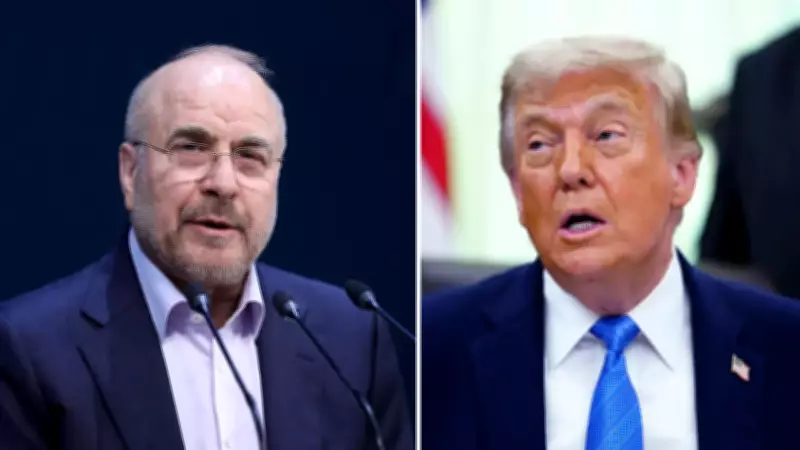
Iran's chief negotiator and Parliament Speaker Mohammad Bagher Ghalibaf has warned that Tehran will deliver a 'crushing response' if the United States violates the newly signed framework agreement, acts in bad faith, or makes excessive demands during final deal negotiations. In a post on X, Ghalibaf stated that Iran remains committed to implementing the terms set by Supreme Leader Ayatollah Mojtaba Khamenei, but any breach will be met with strong retaliation. 'We are carrying out the mission assigned by the Supreme Leader to ensure the agreement's conditions are fulfilled. In the event of bad faith, a breach of commitments, or excessive demands by the other side, we will not hesitate to deliver a crushing response to the enemy,' he said. Referring to the recent conflict, Ghalibaf added, 'They were slapped once during the war. If they choose to follow that path again, they will receive an even harder slap.'
Khamenei Claims Trump Drove the Deal
Iran's Supreme Leader Mojtaba Khamenei has claimed that US President Donald Trump used 'all kinds of leverage' to secure the newly signed Memorandum of Understanding (MoU) between Tehran and Washington, arguing that the agreement was driven by American urgency rather than Iranian pressure. Addressing the nation after the signing of the 14-point framework agreement, Khamenei said Iranian officials had worked extensively and in good faith during the negotiations, but maintained that it was Trump who was eager to reach a deal. 'As you have been informed, a memorandum of understanding was signed between the presidents of Iran and America. In the course of reaching this stage, the officials in charge made extensive efforts with sincere concern and goodwill. However, it was the American president who, out of desperation, used all kinds of leverage to bring this about,' Khamenei said. While endorsing the agreement, Khamenei stressed that future direct talks with the United States should not be interpreted as Iran accepting Washington's position. 'It is self-evident that the face-to-face negotiations that will take place in the future will not mean acceptance of the enemy's position,' he said. The Supreme Leader also revealed that he initially had reservations about the agreement but ultimately approved it after receiving assurances from President Masoud Pezeshkian and members of Iran's Supreme National Security Council that the rights of the Iranian nation and the Resistance Front would be protected. 'I, as a matter of principle, held a different view. However, based on the commitment given by the president and other members of the Supreme National Security Council to safeguard the rights of the Iranian nation and the Resistance Front, I granted my permission,' Khamenei said. He added that Iranian negotiators had assured him they would reject any attempt by the United States to impose additional conditions during future negotiations.
US Lifts Blockade, Oil Tankers Resume Through Strait of Hormuz
The United States lifted its blockade of Iran on Thursday, allowing oil tankers to freely move through the Strait of Hormuz after months of being unable to use the critical channel, as the tentative agreement to end the war took effect. However, Vice President JD Vance suggested he may postpone a trip to Switzerland planned for Friday, which included a ceremonial signing of the deal. A Trump administration envoy told US lawmakers in a private briefing that Iran will invite the UN's nuclear watchdog agency to inspect its nuclear sites. That all unfolded as Iranian Supreme Leader Ayatollah Mojtaba Khamenei endorsed direct negotiations with the US in a statement read by state media. 'It is obvious that the face-to-face negotiations that will be held in the future will not mean accepting the enemy's opinion,' he said. It was Khamenei's first reaction to the agreement, indicating a shift in Iran's approach. Hard-liners, especially Khamenei's father, the previous supreme leader, have long opposed direct talks, especially after the US pulled out of the 2015 nuclear deal between Iran and world powers. The supreme leader has not been seen in public since he was wounded in a strike at the start of the war.


Hezbollah Claims Destruction of Israeli Tanks in Lebanon
Hezbollah has claimed that its fighters lured an Israeli military force into what it described as a 'kill zone' before destroying three Merkava tanks during clashes near the Ali al-Tahir hill in southern Lebanon. In a statement, the group said it detected an Israeli armoured and infantry unit advancing from the northern side of the hill and targeted it with guided missiles, allegedly destroying three tanks. Hezbollah said it then launched heavy rocket and artillery fire at the force. According to the group, a second Israeli unit later moved in under the cover of smoke screens and flares to evacuate casualties. Hezbollah said it responded with a barrage of rockets and mortar shells, claiming to have scored direct hits.
Vance Warns Israel Over Criticism of Iran Deal
US Vice President JD Vance has issued a strong warning to Israel over its criticism of the US-Iran agreement reached after weeks of conflict and tensions. Defending MAGA supremo, Vance said that 'Trump is Israel's only ally.' His remarks came amid reports that Prime Minister Benjamin Netanyahu and his allies were 'privately unhappy' with the agreement, which was aimed at ending the conflict with Iran. Vance also stressed that Washington remains Israel's strongest and most important ally. Speaking at a White House briefing, Vance defended the agreement amid criticism from critics, who have argued that it fails to adequately address Iran's nuclear and ballistic missile programmes and could constrain Israel's military operations against Hezbollah in Lebanon.
Vance Delays Switzerland Trip for Nuclear Talks
The White House said Thursday night that Vice President JD Vance was delaying a trip to Switzerland to lead a new round of negotiations with Iran over its nuclear program, raising questions about what's next for the tentative agreement to end the war. It said the team led by Vance had been ready to leave but was postponing, citing difficult logistics for negotiations. The announcement followed a report from Al-Mayadeen, a pan-Arab satellite channel politically allied with Hezbollah, that Iran was delaying sending its delegation to Switzerland over Israel's ongoing military campaign in Lebanon. The postponement came after the US said it had lifted its blockade, allowing oil tankers to begin freely moving through the Strait of Hormuz. But the initial agreement has drawn sharp criticism from some in the US, including a few congressional Republicans, who worry Washington ceded too much to Iran with relief from sanctions and a potential $300 billion fund to help with rebuilding. Earlier, Vance took the relatively unusual step of appearing at the White House to defend the deal, arguing that while it offers concessions, Iran first has to comply with US demands.
US Envoy Says Iran Will Invite IAEA Inspections
US special envoy Steve Witkoff told lawmakers in a private briefing that Iran would invite the International Atomic Energy Agency (IAEA) to inspect its nuclear facilities and help locate enriched uranium believed to be buried under rubble. According to reports, a separate letter between Tehran and the UN nuclear watchdog outlines the inspection process. Vice President JD Vance also defended the agreement, arguing that it would force Iran to change its behaviour. Responding to criticism from Israel, Vance said President Donald Trump remains the country's strongest ally and warned against undermining the deal.
Agreement Details and Reactions
The agreement, signed virtually by President Donald Trump and Iranian President Masoud Pezeshkian, reopened the Strait of Hormuz, established a framework for de-escalation, and launched a 60-day process aimed at negotiating a broader accord covering sanctions, security issues and Iran's nuclear programme. Iran's Ambassador to India, Mohammad Fathali, described the agreement as a possible turning point for regional and global stability if all sides honour their commitments in good faith. Trump has argued that the deal would help stabilise oil markets and prevent further economic disruption after the conflict sent energy prices soaring. Shipping activity has already begun to recover. Oil tankers carrying millions of barrels of crude have crossed the Strait of Hormuz, while major global shipping companies have resumed limited operations through alternative routes. However, experts warn that the strait is not yet fully operational, with mine-clearance work still required and hundreds of vessels waiting to leave the Persian Gulf.