

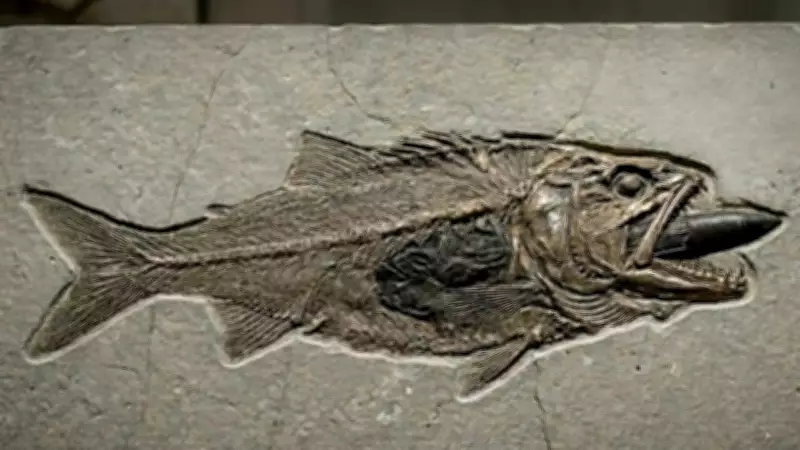
Rare Jurassic 'Fatal Consumption' Event Uncovered in Exceptional Fossils
A remarkable discovery from the Jurassic period has revealed two prehistoric predators that met sudden, suffocating deaths after fatal feeding errors. According to a study published in Scientific Reports (Nature), researchers identified an exceptional fossil of the fish Tharsis that choked to death after accidentally sucking in a streamlined belemnite rostrum—the hard, internal shell of an extinct, squid-like creature.
Second Fossil Specimen Described in Geological Magazine
In addition to Tharsis, a second fossil specimen of Pachycormus macropterus has been described in the Geological Magazine by researcher Samuel Cooper from the University of Portsmouth. This animal was also a predator and choked to death after attempting to consume a large ammonite shell. Both of these fossils, termed 'pabulites' (fossilised final meals), illustrate instances of evolutionarily significant predatory error and highlight the risk of fatal choking on hard shells for apex predators.
The Science of Death by Choking: Why the Floating Squid Was a Lethal Trap
While modern squids are entirely soft-bodied, their Jurassic ancestor, the belemnite, carried a rigid internal skeleton that made them a high-risk prey item. Although their bodies were soft, belemnites contained a hidden, hard weapon known as a rostrum, which made them extraordinarily dangerous for any creature.

The rostrum is a bullet-shaped, calcified internal 'guard' with a density similar to bone, providing the belemnite with structural rigidity but acting as a lethal wedge for any predator. The streamlined, conical shape of the rostrum allowed it to slide effortlessly into the Tharsis fish's gullet; however, its orientation created a mechanical lock that prevented the predator from ejecting it. Once the rostrum is sucked into the narrow gullet of the fish, it fits perfectly tight against the back teeth of the fish, making it impossible for the fish to either swallow or eject the rostrum.
The Biological Cost of a Bad Bite
There wasn't a gradual death; advanced CT scanning and 3D reconstruction by the University of Portsmouth revealed that the prey's position physically locked the fish's gill covers open, leading to almost immediate death. The primary cause of death was asphyxiation due to a serious obstruction of the gills. The ammonite or belemnite shell had such a large size that it physically blocked enough water to flow over the fish's gills.
Without sufficient water flowing over its gills, the fish could not get enough oxygen, and so the scientists believe these predators died from suffocation shortly after making their final strike. When the predator died, it sank quickly into the anoxic muck of the ocean floor and was not accessible to scavengers. This act of 'sudden burial' acted as a natural time capsule that preserved this ancient crime scene in pristine condition for millions of years, according to the study published in Scientific Reports (Nature).
Why Did These Apex Predators Mess Up?
Risks associated with suction feeding: Many Jurassic Period fishes used suction feeding by quickly opening their mouths wide and sucking in everything they came across, sometimes causing them to eat debris that might be harmful to them.
Misidentification of prey: Researchers suggest these predators likely mistook buoyant, empty shells for live, soft-bodied prey. In the murky Jurassic waters, the window to distinguish a soft squid from a hard shell was a mere fraction of a second, leading to a fatal split-second error.
These findings provide a unique glimpse into the evolutionary pressures and survival challenges faced by ancient marine predators, underscoring how even apex hunters were vulnerable to catastrophic mistakes in their feeding strategies.






