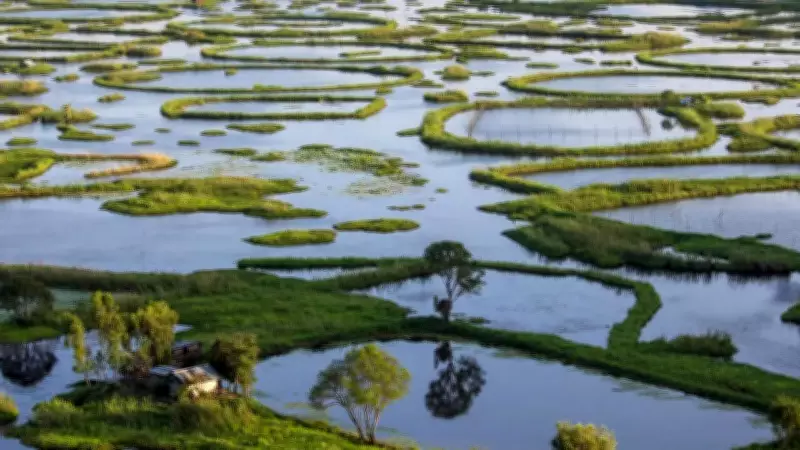
Amidst the lush green valleys of Northeast India's Moirang in Manipur lies a mysterious body of water that appears as a massive circular patch of oversized lily pads. However, a closer look reveals that these are not leaves at all, but a vast network of perfectly circular, floating islands. This is Loktak Lake, the largest freshwater lake in the region, known for its surreal landscape that serves as a vital ecological sanctuary and home to some of the planet's most remarkable wildlife, including one of the longest snakes on Earth.
The Phumdis
These bizarre circular islands are locally known as phumdis. Far from being solid land, they are actually floating masses of vegetation, soil, and various organic matters in different stages of decomposition. Despite their buoyant, spongy nature, the phumdis are incredibly resilient. They are packed tightly enough and thick enough to support the weight of entire structures, including the homes of local fisherfolk who live their lives directly on the water.
The World's Only Floating National Park
The extraordinary nature of this lake reaches its peak within the Keibul Lamjao National Park, which holds the unique distinction of being the world's only floating national park. The entire park spans an area of 40 square kilometers, with the floating phumdis accounting for roughly six square kilometers. According to data from NASA, this highly specialized environment acts as a haven for biodiversity. It is home to around 200 species of aquatic plants and 400 species of animals. Among these residents is the rare Indian python—celebrated as one of the longest snakes in the world—which thrives within the island network.

Home of the Dancing Deer
Beyond its massive pythons, the lake is the ultimate sanctuary for the Sangai deer, also known as the brown-antlered deer. By 1950, the species was feared to be nearly extinct. However, following dedicated conservation and protection efforts from the State of Manipur, their population has slowly and steadily increased. The Sangai deer are affectionately nicknamed the "dancing deer" because of the way they have to balance and move around on the surface of the unstable phumdis.
A Unique Habitat Facing Modern Threats
The phumdis are in trouble due to several problems. The water level is rising because of climate change and human constructions. In the 1980s, the Ithai Dam was built, causing water to accumulate in Loktak Lake and completely altering the natural flow of the Imphal River. The phumdis are now permanently flooded, disrupting their ecological function. The floating phumdis are very fragile and need careful management. The people who live on the phumdis and the phumdis themselves are under threat.
Because the water remains permanently high, the roots of the phumdis can no longer sink down to reach the lakebed to absorb critical nutrients during the dry season. Starved of these minerals, the floating islands are progressively becoming thinner and face a highly uncertain future.