

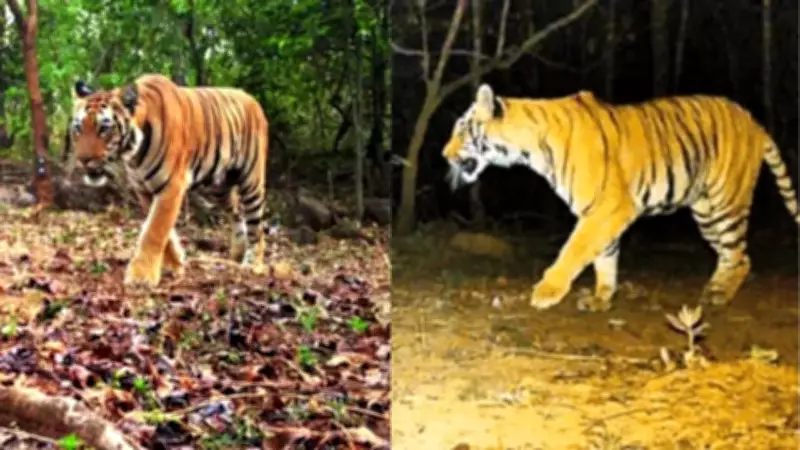
RAIPUR: A mysterious tigress, with no trace in any database or camera trap records from three neighbouring states, has taken up residence in the Udanti-Sitanadi Tiger Reserve in Chhattisgarh. The four-year-old predator was first photographed by forest officials in January, and subsequent images from April and May confirm she has stayed in the depleted reserve, about 160 km southeast of Raipur, which conservationists had nearly written off as a tiger homeland.
No Match in Tiger Archives
Researchers sent stripe patterns to the Wildlife Institute of India, but no match was found in any recorded tiger population across India. Scat samples analysed at Nanaji Deshmukh Veterinary Science University in Jabalpur confirmed the animal was female. Yet her origins remain unknown. "She has no identifiable trail in adjoining landscapes. That is what is baffling everyone," said Varun Jain, deputy director of the reserve.
Unusual Behavior for a Female Tiger
Tigresses seldom roam as widely as males. Territorial females usually disperse within 150 km to 200 km of their birth areas, while males can travel over 1,000 km in search of territory and mates. This cat appears to have moved across the forests of Odisha, Maharashtra, and Madhya Pradesh without leaving any sign in monitoring records.

A Boost for Conservation Efforts
Her arrival has electrified conservationists because Udanti, located in dense forests near the border with Odisha, had been losing its tiger population for years. The All India Tiger Estimation counted three tigers in 2014, including a resident tigress. By 2018, only one tiger remained. A dispersing male from Kawal Tiger Reserve in Telangana trekked nearly 700 km into Udanti in 2022 before moving towards Odisha. Another tiger surfaced briefly in 2025.
Officials had begun accepting that Udanti was becoming a jungle crossroads, not a kingdom. Transient males passed through and moved on towards safer habitats, often in the direction of Barnawapara Wildlife Sanctuary, about 100 km east of Raipur. Without a resident tigress, males had little reason to establish territory inside the reserve.
Natural Reintroduction
This vacuum pushed Chhattisgarh towards a formal tiger reintroduction plan. A proposal sent to the National Tiger Conservation Authority in November 2024 sought to relocate two females and one male into Udanti. The environment ministry granted in-principle approval while asking officials to complete prey-base assessments. Then the forest played its own hand. "The tigress looks like a possible example of natural reintroduction," Jain said. "Nature may have started recolonising a landscape humans were trying to revive on paper."






