

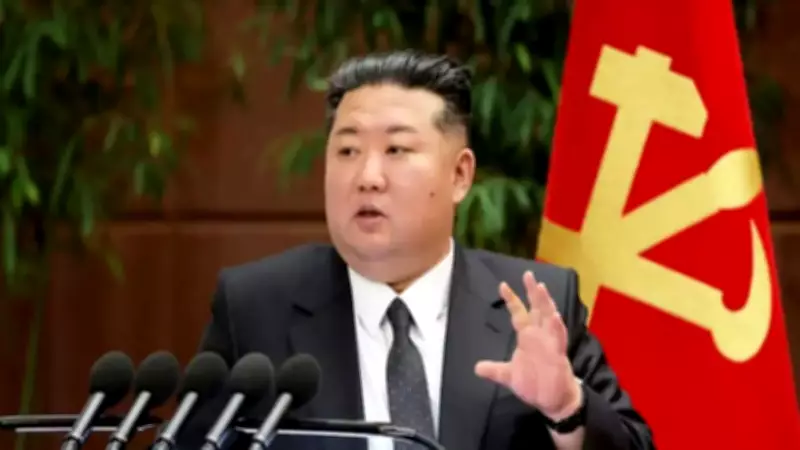
North Korea has revised its nuclear policy to authorize an automatic nuclear attack if leader Kim Jong-un is assassinated or immobilized in a foreign attack, according to reports from South Korean intelligence officials. The constitutional revision came into view during the first session of North Korea's 15th Supreme People's Assembly, held in Pyongyang on March 22. The details regarding the amendments were shared first with senior South Korean officials by the National Intelligence Service (NIS), as reported by The Telegraph.
Key Changes in Nuclear Doctrine
Under the revised law, Kim Jong-un remains the supreme authority of North Korea's nuclear arsenal. However, the updated law states that retaliatory measures must be taken in the case that the country's leadership is targeted or threatened. This move is somewhat inspired by the series of high-profile assassinations of senior Iranian leaders, including Supreme Leader Ayatollah Ali Khamenei and key military advisers, during joint US-Israeli military operations.
Professor Andrei Lankov of Kookmin University said that North Korea may have maintained such statements informally in the past, but formally making it a law signals growing concern over leadership-targeted attacks. "Iran was the wake-up call. North Korea saw the remarkable efficiency of the US-Israeli decapitation attacks, which immediately eliminated the greater part of the Iranian leadership, and they must now be terrified," said Lankov to The Telegraph.

Challenges in Replicating Decapitation Strikes
Security analysts state that duplicating similar intelligence operations in North Korea would be far more difficult due to its extreme isolation and highly secured and controlled surveillance system. Unlike Iran, North Korea has minimal foreign presence, heavily restricted internet access, and limited civilian CCTV infrastructure. Even foreign diplomats, medical workers, and business visitors are regularly monitored by state authorities.
Recent reports have suggested that the Israeli intelligence agency was able to track Iranian leaders by hacking traffic cameras and digital surveillance systems in Tehran. Experts believe such tactics would be difficult to execute in Pyongyang because of the area's closed communication systems.
Kim Jong-un's Personal Security
Kim Jong-un is also known for his intense personal security. He travels with a heavily armed convoy, avoids air travel, and mostly travels in an armored train for long distances. Lankov also added, "Their biggest fear is going to be information from satellite technology. And, on balance, their concerns are not unfounded as taking out the leadership at the outset of any conflict is likely to be decisive."
Kim recently inspected the production of a "new-type 155-millimetre self-propelled gun-howitzer," capable of striking targets over 37 miles away. Seoul is located roughly 35 miles from the heavily guarded border. According to KCNA, the artillery system is expected to "provide significant changes and advantages to our military's ground operations."






