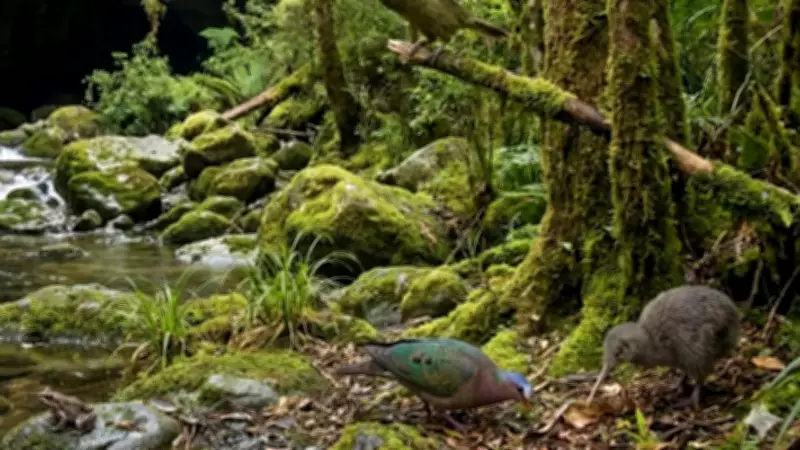
Ancient Cave Discovery Rewrites New Zealand's Prehistoric Narrative
For decades, the ancient history of New Zealand has remained frustratingly fragmented, with scattered fossils and substantial gaps leaving scientists with an incomplete picture of the nation's distant past. This narrative of uncertainty has now been dramatically transformed by a remarkable discovery in a cave near Waitomo on the North Island.
Unearthing a Million-Year-Old Time Capsule
Within this previously unexplored cavern, researchers have uncovered exceptionally preserved remains of wildlife that thrived approximately one million years ago. The find represents what scientists describe as stumbling upon an entire missing chapter—or perhaps even a complete lost volume—of New Zealand's natural history. These fossils provide compelling evidence that Aotearoa once supported ecosystems vastly different from contemporary landscapes, featuring dense prehistoric forests, dramatic climate fluctuations, and violent volcanic eruptions that reshaped life long before human settlement.
The Significance of New Zealand's Oldest Cave
The cave itself constitutes a major archaeological breakthrough, with researchers identifying it as the oldest known cave yet discovered on New Zealand's North Island. What makes this site particularly valuable is its remarkable geological context. The fossils were perfectly preserved between two distinct layers of volcanic ash—one from an eruption approximately 1.55 million years ago, and another from a massive volcanic event around one million years ago.

This volcanic sandwich provided scientists with something exceptionally rare in paleontology: precisely dated fossil evidence. Most volcanic ash deposits erode over millennia, but here they created an ideal preservation environment. Within this geological time capsule, researchers discovered remains of at least twelve distinct bird species and four frog species that had remained undisturbed for eons.
Revealing Cycles of Extinction and Renewal
The fossil collection offers unprecedented insights into New Zealand's prehistoric ecosystems, revealing that the country's wildlife was already experiencing dramatic cycles of extinction and renewal long before human influence. According to research published in the journal Alcheringa, titled The first Early Pleistocene (ca 1 Ma) fossil terrestrial vertebrate fauna from a cave in New Zealand reveals substantial avifaunal turnover in the last million years, an astonishing thirty to fifty percent of species may have disappeared during the million years preceding human arrival.
Associate Professor Trevor Worthy from Flinders University emphasizes that this represents a completely distinct avifauna—not merely ancestral versions of modern birds, but an entirely different ecological community that failed to survive subsequent environmental challenges. This discovery suggests that extinction events were not exceptional occurrences in prehistoric New Zealand, but rather formed an integral part of the natural rhythm of ecosystem evolution.
Volcanic and Climatic Drivers of Ancient Extinctions
What caused these dramatic species turnovers? The evidence strongly points toward natural environmental forces, including rapid climate shifts and repeated volcanic eruptions of enormous scale. One particularly massive eruption approximately one million years ago reportedly blanketed much of the North Island under meters of volcanic ash, devastating forests, eliminating food sources, and erasing habitats almost instantaneously.
Dr. Paul Scofield from Canterbury Museum describes this process as a kind of ecological reset, where dense forests transformed into shrublands before potentially reverting again. Birds faced relentless pressure to adapt or face extinction, creating what researchers imagine must have been brutally challenging survival conditions.

Ancient Kākāpō Ancestor Reveals Evolutionary History
Among the most fascinating discoveries is a newly identified parrot species named Strigops insulaborealis, an ancient relative of today's Kākāpō—the heavy, flightless parrot that has become an iconic symbol of New Zealand conservation. This prehistoric ancestor exhibits significant differences from its modern counterpart, featuring a lighter build and weaker legs that suggest it may have possessed flight capabilities, or at least greater mobility than today's ground-bound descendant.
This revelation fundamentally reframes our understanding of the Kākāpō, transforming it from an evolutionary oddity into the product of long-term adaptation processes. The cave also yielded an extinct ancestor of the Takahē and a pigeon closely related to Australian bronzewing pigeons, providing subtle evidence of historical ecological connections across the region.
This extraordinary discovery in New Zealand's oldest cave not only fills critical gaps in the nation's prehistoric record but also offers profound insights into how natural forces have continuously reshaped ecosystems through cycles of destruction and renewal over geological timescales.