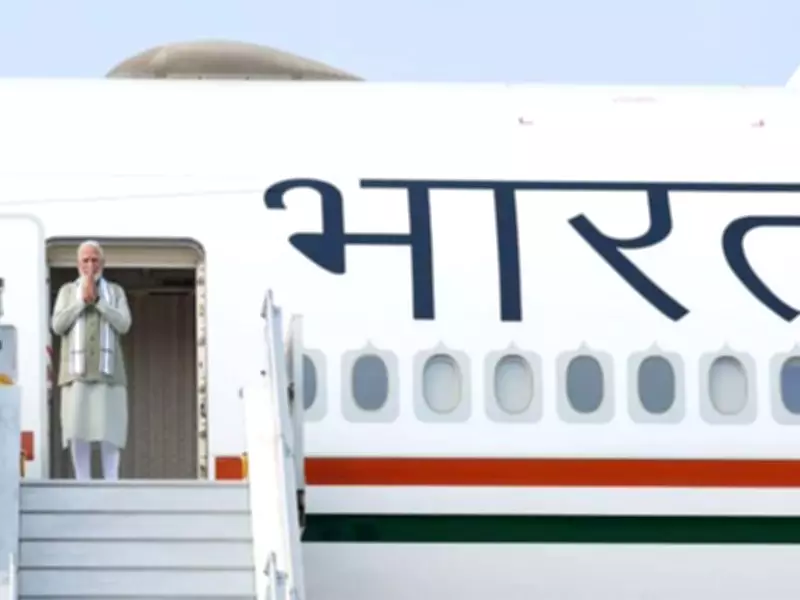
Prime Minister Narendra Modi departed on Monday for a six-day visit to Indonesia, Australia, and New Zealand, aiming to reinforce India's Act East Policy, advance the "MAHASAGAR" vision, and deepen commitment to a free, open and inclusive Indo-Pacific. The visit, scheduled from July 6 to 11, capitalizes on robust momentum in India's relations with the three key partners, expanding cooperation across strategic, economic and people-centric sectors.
MAHASAGAR Vision and Strategic Framework
The "MAHASAGAR" framework—Mutual and Holistic Advancement for Security Across the Regions—represents India's institutional blueprint for fostering security, stability and inclusive growth across the maritime domain. PM Modi stated that the high-level engagement would strengthen India's Act East Policy, MAHASAGAR Vision, and outlook towards a free and open Indo-Pacific.
Indonesia: First Leg of the Visit
The Prime Minister commenced the first leg in Indonesia from July 6 to 8 at the invitation of President Prabowo Subianto. This is his fourth visit to the maritime neighbor and the first bilateral visit since the relationship was elevated to a Comprehensive Strategic Partnership in May 2018. PM Modi recalled that the two democracies elevated their ties during his 2018 visit, and noted that this marks his first bilateral visit since then, following President Prabowo's visit to India as the Chief Guest for Republic Day celebrations in January 2025.

During his schedule, PM Modi will interact with the Indian diaspora and accompany President Prabowo to the Prambanan Temple Complex in Yogyakarta, a UNESCO-listed site symbolizing deep cultural links between the two nations.
Defence and Maritime Cooperation
Advancing defence and maritime cooperation is a cornerstone of the bilateral agenda. Strategic security ties have achieved robust momentum, characterized by expanding high-level visits, regular bilateral and multilateral exercises, and deeper defence industry cooperation, including the significant sale of BrahMos missiles. Both democracies adopted the Shared Vision of India-Indonesia Maritime Cooperation in the Indo-Pacific in 2018. To enhance maritime domain awareness, an Indonesian Liaison Officer will be stationed at the Information Fusion Centre-Indian Ocean Region (IFC-IOR) in India. Additionally, New Delhi will earmark dedicated training slots for Indonesian cadets and officers at the National Defence Academy (NDA) and the Defence Services Staff College (DSSC).
Economic and Trade Collaboration
Economic collaboration remains positioned to drive growth through expanded trade and mutual investments. Strong institutional synergies have emerged between Viksit Bharat 2047 and Emas (Golden) Indonesia 2045. Indonesia is India's second-largest trading partner within ASEAN, with bilateral trade reaching USD 24.78 billion in the 2025-26 fiscal year. More than 130 Indian enterprises maintain active investments across diverse sectors of the Indonesian economy.
Addressing regional food stability, India has extended support to Indonesia's food security priorities, notably through the critical supply of 100 tonnes of high-quality "DWR 162" wheat seeds. Critical mineral cooperation is also set to take centre stage, as Indonesia commands roughly 21 per cent of the world's nickel reserves and ranks among top global producers of copper, bauxite and tin.
Development Cooperation and Digital Public Infrastructure
Indonesia increasingly views India as a vital development partner, having dispatched official delegations to study India's Public Distribution System (PDS), rice fortification scheme, fertiliser subsidy reforms, and the digital "AGRISTACK" agricultural platform. Indonesia's Free Nutritious Meals initiative, which expanded from 3 million to 36 million recipients under President Prabowo, is explicitly modelled on India's PM POSHAN Mid-Day Meal programme. Similarly, Jakarta's Red and White Village Cooperatives aim to establish 80,000 self-sufficient economic hubs, with a government-to-government bulk supply framework for affordable medicines patterned after India's "Jan Aushadhi" model.

Digital public infrastructure is a transformative front for bilateral integration. Connectivity between India's Unified Payments Interface (UPI) and Indonesia's QRIS digital payment ecosystems is being finalized, enabling simpler cross-border transactions. The Indonesia Open Network (ION), modelled on India's Open Network for Digital Commerce (ONDC), is designed to create fairer access to digital markets for MSMEs.
Cultural Bonds and People-to-People Ties
Deepening civilisational bonds anchor the geopolitical relationship, rooted in a shared cultural and maritime history spanning more than a millennium. PM Modi and President Prabowo will jointly visit the Prambanan Temple Complex, the largest temple complex dedicated to Lord Shiva in Indonesia. India will officially commemorate the centenary of Gurudev Rabindranath Tagore's historic visit to Indonesia in 2027.
Subsequent Legs: Australia and New Zealand
Following Indonesia, the second leg takes the Prime Minister to Melbourne, where he will hold talks with Australian counterpart Anthony Albanese to expand the India-Australia Comprehensive Strategic Partnership. Discussions will focus on defence, security, trade, investment, education, mobility, and people-to-people exchanges. PM Modi also looks forward to interacting with the Indian community in Melbourne, calling the diaspora an "important pillar" of the bilateral relationship.
The final stop is Auckland, where PM Modi will meet New Zealand Prime Minister Christopher Luxon to build on momentum from Luxon's March visit to India. The two leaders will discuss ways to expand economic, trade and commercial engagement following the signing of the India-New Zealand Free Trade Agreement. PM Modi noted the significant contribution of the Indian diaspora and looks forward to addressing a large gathering of the Indian community.