

Pune: The smuggling trend at Pune airport is quietly shifting, with traffickers increasingly turning to high-profit hydroponic weed. Customs officials said the trend was driven by multiple factors.
Why Hydroponic Weed?
Rahul Galande, additional commissioner of customs, Pune, told TOI: "Smugglers are gravitating towards hydroponic weed because it offers substantially higher profit margins, far greater potency than traditional marijuana, and is easier to hide during transit in most cases."
Unlike other narcotics, the pricing of hydroponic cannabis is largely controlled by illegal networks. "Based on assessments by the Narcotics Control Bureau, 1 kg can fetch around Rs 35 lakh in the illicit market. Earlier estimates by the Directorate of Revenue Intelligence had put the value closer to Rs 1 crore per kg," Galande said.

Targeting Pune's Softer Route
Officials said smugglers were deliberately exploiting Pune airport's relatively lower international cargo traffic. "There is a strong possibility that traffickers are attempting to convert Pune into a transit hub for the entry and distribution of contraband, seeing it as a softer route compared to Mumbai or other major airports in Maharashtra," another customs official said.
In 2025 alone, Pune airport customs detected 11-12 cases involving hydroponic weed and arrested at least 12 carriers. The largest seizure occurred on March 26, when officials intercepted 76.6 kg of hydroponic weed concealed in an international cargo consignment, valued at about Rs 26.8 crore. The consignment had been routed through a non-regular customs house agent (CHA). "The strategy was simple. Exploit low-cargo volumes and slip under the radar," Galande said.
Authorities have identified Pune and Mumbai as major consumption centres. "Both cities have a diverse clientele, students, young professionals and affluent users, and a social culture that supports steady demand," the official added.
Gold Losing Its Spark
Gold, once a preferred smuggling commodity, has suffered a hit after customs duty was reduced from 15% to 6% in late 2025. Combined with rupee-dollar volatility, the margins have narrowed significantly. "If a gold consignment is seized, the losses are enormous and often impossible to recover. For many operators, the risk is no longer worth it," another customs official said. "Gold is usually traded on borrowed capital or informal credit, so seizures leave smugglers burdened with heavy debt," he said.
Customs Tightens the Net
D Anil, commissioner of customs and CGST for the Pune Zone, underscored the role of customs house agents in preventing such smuggling attempts. "CHAs are duty-bound to verify KYC details of importers and ensure full compliance. These norms will now be enforced more strictly," he said.
Local Nexus and Thailand Link
The Khadki police had in November-December last year busted a hydroponic weed production unit operating out of a rented flat in Hinjewadi. Two MBA graduates were arrested for running the operation. Deputy commissioner of police Somay Munde said investigations revealed a wider international link. "The suspects were importing hydroponic weed from Thailand via Bhutan and Assam to Pune. The drug, also known as OG Kush, is in high demand in the city," he said.
In several cases, the narcotics were concealed inside LED bulb strips and other electronic equipment. "We suspect that individuals from Pune are in direct contact with traffickers in Thailand and are using gullible carriers to transport drugs through different routes," Munde added.
Last month, the Uttamnagar police arrested two engineers in possession of imported OG Kush worth Rs 6.5 lakh. Investigators confirmed that the contraband had originated in Thailand and further probe is underway.
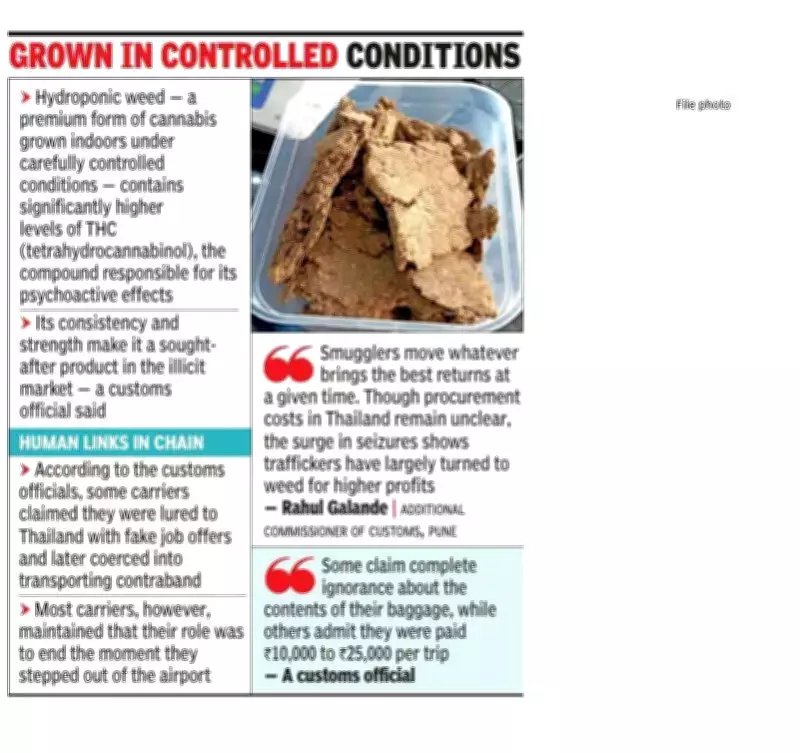
Graphic: Grown Under Controlled Conditions Indoors
Hydroponic weed — a premium form of cannabis grown indoors under carefully controlled conditions — contains significantly higher levels of THC (tetrahydrocannabinol), the compound responsible for its psychoactive effects. Its consistency and strength make it a sought-after product in the illicit market — a customs official said.

Human Links in the Chain
According to the customs officials, some carriers claimed they were lured to Thailand with fake job offers and later coerced into transporting contraband. Most carriers, however, maintained that their role was to end the moment they stepped out of the airport. "Some claim complete ignorance about the contents of their baggage, while others admit they were paid Rs 10,000 to Rs 25,000 per trip," a customs official said.
"Smugglers move whatever brings the best returns at a given time. Though procurement costs in Thailand remain unclear, the surge in seizures shows traffickers have largely turned to weed for higher profits," said Rahul Galande, additional commissioner of customs, Pune.





