

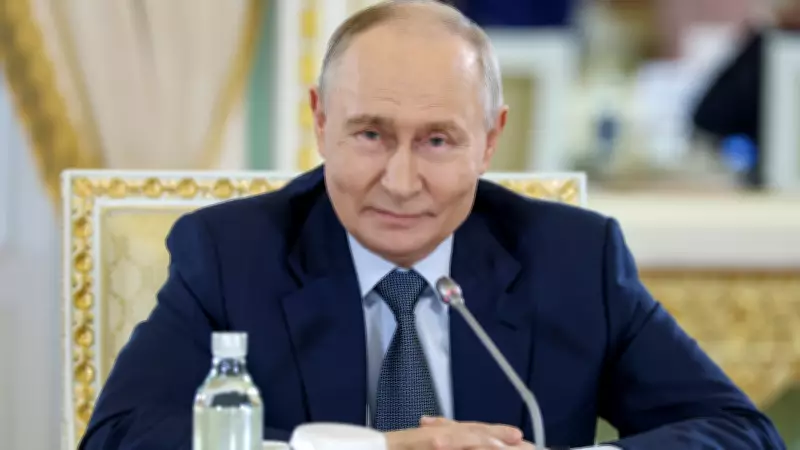
Russian President Vladimir Putin has made a strong pitch to India for his country's fifth-generation Su-57 stealth fighter jet, offering New Delhi full co-development and co-production without any restrictions. Speaking to an Indian journalist during a meeting with heads of leading global news agencies, Putin recalled Russia's earlier invitation to India to jointly build the aircraft.
Putin's Offer and India's Response
"As for the Su-57, we offered our friends from India to jointly develop this machine, a fifth-generation aircraft. I think it's the best to date. But our Indian friends said, 'well, let's see'," Putin said. He noted that the joint project could have been a Russia-India product, but India withdrew from the joint development, leading Russia to develop the fighter independently.
India and Russia initiated the Fifth Generation Fighter Aircraft (FGFA) program in 2007 to co-develop an advanced stealth fighter based on the Su-57. After more than a decade of negotiations, India formally withdrew in 2018 due to unresolved issues over costs, technology transfer, and performance. Putin emphasized that Russia is ready to work with India on the Su-57 with no limitations. "Su-57 could be a joint venture between us. We developed it ourselves, and we're certainly ready to work with India, supplying and developing it further. There are no restrictions here; we have no limitations whatsoever," he said.

Broader Defence Cooperation
On defence cooperation, Putin stated that Russia is prepared to continue collaboration with India in areas such as the BrahMos missile programme, fifth-generation technologies, fighter aircraft, and air defence systems. "Russia is prepared to expand cooperation with India and share advanced defence technologies," he added.
India's Own AMCA Project
India is pursuing its own Advanced Multirole Combat Aircraft (AMCA) project, but has not closed the door on the Su-57. In April, the then chairman of Hindustan Aeronautics Ltd, D K Sunil, confirmed that Russia had presented the Su-57's capabilities to the Indian Air Force (IAF). "I think presentations have been made regarding the Su-57 to the Air Force team by the Russian team regarding the capabilities of the aircraft. We are awaiting the Russian quotation about the investment. Then we will approach the air force that these are the kind of numbers required to produce these aircraft and these are the timelines," he said.
With India's AMCA unlikely to enter service before 2035, the IAF may consider procuring at least two squadrons (around 36) of Su-57s, provided Russia meets all technical specifications. The IAF's squadron strength has dwindled to 29 from an ideal 42.5, while China is working on two sixth-generation fighter projects and Pakistan has signed an initial agreement to acquire 40 Chinese Shenyang J-35 fifth-generation stealth fighters.
Historical Ties and Diversification
The IAF has relied on Russian fighter jets for nearly six decades, starting with the MiG-21 in the 1960s. The modern fleet includes the Su-30MKI and MiG-29. To reduce dependence on a single supplier, India has diversified by purchasing 36 French Dassault Rafale jets and has issued a Letter of Request for 114 more Rafale jets. Through its Atmanirbharta (self-reliance) initiatives, the government is shifting towards domestically produced jets like the HAL Tejas Mk-1 and Mk-2 and the AMCA.






