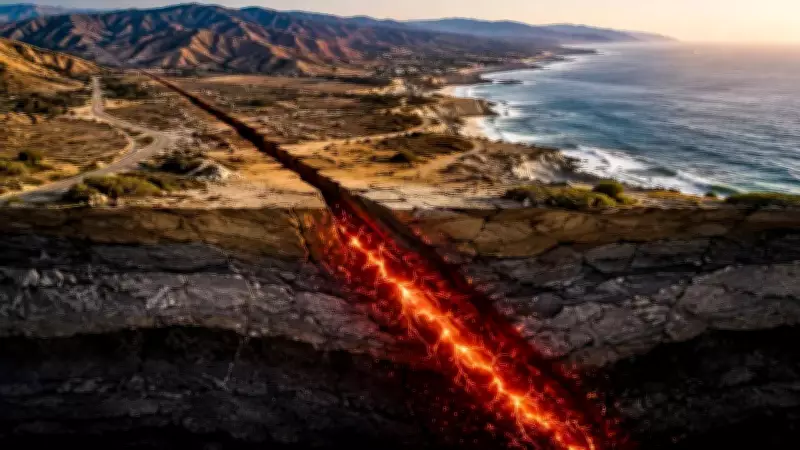
The San Andreas Fault, long embedded in California’s public imagination, has once again drawn scientific attention after new analysis suggested it may be holding more accumulated stress than at any point in the past thousand years. The finding does not come with any reliable sense of timing, but it has reopened questions among researchers who study the slow movement of tectonic plates beneath the state. Stretching for hundreds of miles across desert, city edges and coastal ground, the fault has stayed relatively quiet in recent decades. That quiet is part of what makes the current assessment stand out, as pressure appears to be building in sections that have not released major energy in a long time.
The San Andreas Fault at Cajon Pass: A Meeting Point of Shifting Geological Forces
According to the study published in AGU Journals, titled ‘Cajon Pass and the Southern San Andreas Fault System: Earthquake Cycle Stress Accumulation and Present-Day Loading’, one area that repeatedly comes up in discussions is the Cajon Pass, where multiple fault strands meet and interact. It is a narrow geological corridor, but an important one, acting as a transition point between different segments of the broader system.
Past earthquakes in California have sometimes used this kind of junction to extend rupture lengths beyond what a single fault strand might suggest. That does not mean it will happen again in the same way, but it remains a known possibility in seismic modelling. The difficulty lies in how these connections behave under stress. They do not fail in uniform or easily readable patterns.

What the Findings Do Not Claim
Researchers involved in the work have been careful about its limits. Elevated stress does not translate into an imminent event, and there is no mechanism in the data that points to a specific timeframe. Small tremors along the fault are common and do not appear to significantly reduce deeper strain. They are part of the region’s ongoing seismic background rather than evidence of a system gradually emptying itself. That distinction matters in how the findings are interpreted. The science describes accumulation, not prediction.
Possibility of a Larger Connected Rupture
The AGU Journals affiliated with the University of Hawaii reveals: “The conditions that determine whether the ‘earthquake gate’ at Cajon Pass opens or stays closed appear to be related to how closely the stress levels on the two fault systems are aligned with each other at the time of rupture,” says lead author Liliane Burkhard. Historical earthquakes offer mixed examples. Some have remained localised, while others have extended across greater distances. The San Andreas system appears capable of both behaviours depending on how stress is distributed at the moment of failure. This variability is part of what makes long-term assessment difficult.
Understanding the San Andreas Fault: Historical Patterns and Present Strain Build-Up
Life across much of the San Andreas corridor carries on without much attention to what lies beneath it. Roads, homes and entire towns sit directly above a system that rarely shows itself in visible ways. As reported by the University of Hawaii, researchers supplied the model with a reconstructed 1,000-year history of earthquakes in the region, using geological evidence including radiocarbon dating of displaced sediments and tree-ring data. They then projected the simulation forward to the present day to estimate the amount of tectonic stress that has accumulated over time.
The fault is not a single break but a network of linked fractures, each behaving differently depending on local conditions. Some segments have moved in recent memory, while others have remained largely still, storing strain that does not simply disappear with time. The latest interpretations are shaped by reconstructed records that stretch back centuries. Instead of focusing on individual earthquakes, researchers have tried to piece together how energy has shifted across the system over long periods.