For many years, archaeologists were uncertain about Sanxingdui and its significance. It became known for its massive bronze faces, towering metal trees and gold-sheathed masks, which seemed unlike traditional Chinese civilisation and raised questions about who made them, why they were buried and what kind of society produced them. That changed when archaeologists unearthed a buried palace quarter. The discovery shifted the focus from isolated treasures to a living civilisation with architecture, organisation and scale.
From a 'Disappeared' Kingdom to an Urban Capital
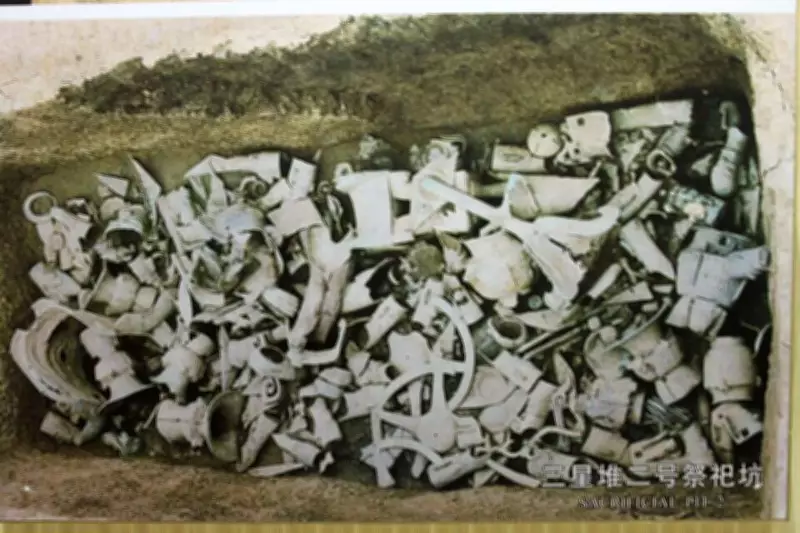
The first hints of Sanxingdui appeared when a farmer digging a ditch accidentally unearthed a deposit of jade relics. But it was in 1986, when archaeologists discovered two sacrificial pits packed with thousands of artefacts made from bronze, gold, jade, ivory and pottery. The discovery brought a long-lost world into view. A Heritage Science paper described Sanxingdui as important evidence of the ancient Shu kingdom, a civilisation that had largely faded from historical memory. Still, the recent discovery of the palace quarter has added a new dimension to that understanding. Researchers are now asking different questions about the site. Rather than focusing solely on the remarkable objects buried at the site, researchers are now exploring how the people of Sanxingdui lived, governed, and organised their society in Bronze Age Sichuan.
How Did the Discovery of the Buried Palace Quarter Contribute to Chinese History?
Long before the palace quarter was discovered, Sanxingdui had already shown signs of being far more than a site filled with ancient treasures. A recent study on Characterising ancient jade by on-site analysis in Sanxingdui, China, noted that the artefacts in the sacrificial pits are best understood in their archaeological context, because where and how they were buried matters as much as the objects themselves. Later excavations uncovered the palace quarter, suggesting that these antiquities came from a thriving city with its own rulers, residents and daily life. One of Sanxingdui's iconic bronze masks stands as a testament to this advanced culture. For a long time, histories of ancient China focused on the dynasties of the Central Plains. Still, the buried chambers showed that the ancient Shu kingdom was a sophisticated civilisation flourishing in southwestern China during the Bronze Age. The excavation reminds historians that interconnected regional cultures shaped China, each playing a role in its history.

Questions That Remain Unanswered
At Sanxingdui, the artefacts and the palace quarter are finally coming together. The bronze pieces have neither lost their mystery nor their appeal. If anything, they have gained a new meaning. They are no longer just museum objects recovered from a sacrificial pit. They have become an essential part of a broader story about a city, a kingdom and the people who built it. Yet the questions remain, as no one knows exactly why the city declined. Some researchers suggest earthquakes and changing river systems may have disrupted life in the region. Others believe the population gradually relocated to the nearby Jinsha site, where similar cultural traditions later appeared, and if so, then why did the people of the civilisation deliberately burn and bury their precious belongings in sacrificial pits? Although the sacrificial pits answered some questions, they also raised new ones.
About the Author: The TOI Science Desk stands as an inquisitive team of journalists, ceaselessly delving into the realms of discovery to curate a captivating collection of news, features, and articles from the vast and ever-evolving world of science for the readers of The Times of India. Consider us your scientific companion, delivering a daily dose of wonder and enlightenment. Whether it's the intricacies of genetic engineering, the marvels of space exploration, or the latest in artificial intelligence, the TOI Science Desk ensures you stay connected to the pulse of the scientific world. At the TOI Science Desk, we are not just reporters; we are storytellers of scientific narratives. We are committed to demystifying the intricacies of science, making it accessible and engaging for readers of all backgrounds. Join us as we craft knowledge with precision and passion, bringing you on a journey where the mysteries of the universe unfold with every word.