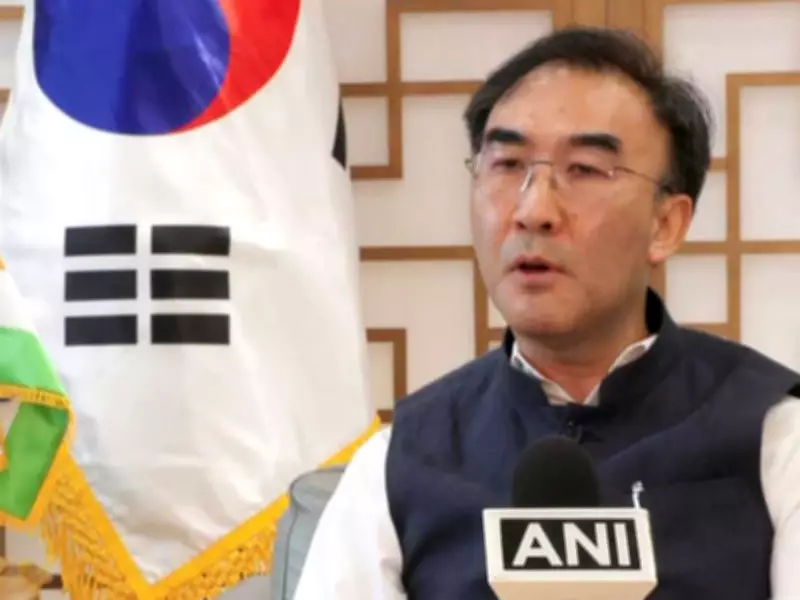
South Korea is focusing on artificial intelligence (AI) collaboration with India more intensely, as both nations seek to deepen ties in emerging technologies, South Korean Ambassador to India Lee Seong-ho said on Monday. The ambassador highlighted significant potential for partnership in critical minerals and advanced industries.
Ambassador Highlights Mutual Interest in Emerging Technologies
In an interview with ANI, Ambassador Lee stated that the leadership of both countries has expressed keen interest in expanding cooperation in critical and emerging technologies. He noted that New Delhi and Seoul possess enormous potential to further their collaboration in these sectors.
"Those are the emerging critical technologies that are the area of mutual interest for both our countries. Both leaders have shown great interest in broadening and expanding, deepening our collaboration in this emerging technology area," Lee said. "Especially, we are looking at AI collaboration more intensely. Obviously, for critical minerals, India has been paying more attention to this area. We believe we have enormous potential to further explore possibilities in this area."

Joint Strategic Vision Identifies Key Pillars
Under the Joint Strategic Vision for the India-Republic of Korea (ROK) Special Strategic Partnership, issued during South Korean President Lee Jae Myung's state visit to India in April, both countries identified artificial intelligence and critical minerals as key pillars of their future strategic and economic partnership.
Prime Minister Narendra Modi and the South Korean President welcomed the launch of the India-Korea Digital Bridge, a new framework focused on AI, data governance, and digital businesses, while recognizing the importance of enabling technologies such as semiconductors in driving digital innovation. PM Modi highlighted the rapid growth of India's semiconductor industry and invited Korean companies to leverage government incentives and the expanding Indian market.
AI Collaboration and Critical Minerals Cooperation
Both sides agreed to deepen collaboration across AI through joint research, talent development, and innovation, guided by India's "AI for All" vision and South Korea's "MANAV" approach, which emphasizes inclusive and accessible AI. On critical minerals, India and South Korea underscored the need to build secure, resilient, and innovation-driven supply chains amid global uncertainties in energy and resource markets.
According to the joint vision, both countries agreed to cooperate across the entire critical minerals value chain, including geological mapping and exploration using artificial intelligence, strengthening links between their geological survey organizations, and collaborating on the recovery of critical minerals from e-waste and mine tailings as part of circular economy initiatives.
Expanding Cooperation in Advanced Industries
The Joint Strategic Vision also expands cooperation in sectors closely linked to AI and critical minerals, including semiconductors, secondary batteries, telecommunications equipment, shipbuilding, defense manufacturing, and strategic supply chains. This reflects the shared objective of reducing vulnerabilities and enhancing technological resilience.
Speaking about India's growing strategic importance for South Korea amid evolving geopolitical dynamics, the ambassador said New Delhi occupies a central place in Seoul's economic and strategic outlook. "India's importance in Korea's perspective cannot be emphasized too much," Lee said. "India has already become a strategic partner, but if the plans we are trying to implement can be materialized in the coming years, then India and Korea will become integral economic partners... Korea can become a good partner in India's effort to represent the Global South."
Shared Commitment to Rules-Based International Order
The ambassador also underscored the shared commitment of both countries to preserving a rules-based international order. "The global order has been very fragile in many senses. Both India and Korea are like-minded countries that strongly value the importance of upholding a rules-based international order. If we can work together, we can both very constructively contribute to upholding this weakening rules-based international order," he said.

Describing India and South Korea as "ideal natural partners," Lee said the relationship is built on political trust, economic complementarity, and shared values. "Both Korea and India are ideal natural partners for each other, especially in these very fragile, rapidly changing global dynamics," he said. "Politically and historically, we don't have any baggage between our two countries. We are free from past negative interactions; that makes us a very natural partner."
Complementary Strengths of Both Economies
Highlighting the complementary strengths of the two economies, Lee said India possesses scale, talent, and a robust IT ecosystem, while South Korea brings manufacturing expertise that aligns well with India's "Make in India" initiative. "India has the scale, size, talent pool, IT infrastructure, and everything. Whereas Korea has an ageing population and it's a relatively small country, it does have the manufacturing skill and know-how to complement India's 'Make in India' vision," he said. "We believe both countries are ideal natural partners in the 21st century."