

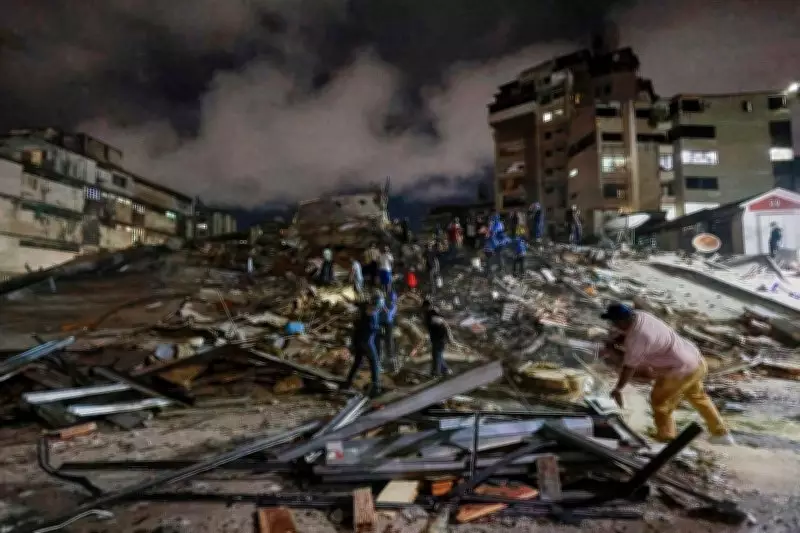
Two powerful earthquakes, with magnitudes of 7.2 and 7.5, struck off the coast of Venezuela on Wednesday evening, June 24, 2026, causing buildings to collapse in the capital Caracas and sending panicked residents into the streets. The tremors were felt across a wide area, including in Brazil's Amazon region about 1,700 kilometers away, where buildings were evacuated in cities such as Manaus, Belem, and Macapa.
Details of the Earthquakes
The US Geological Survey (USGS) initially reported the first earthquake at magnitude 7.1, later revising it to 7.2. Its epicenter was located west of the community of Moron along Venezuela's Caribbean coast, approximately 168 kilometers west of Caracas, at a depth of 22 kilometers. Just one minute later, a second earthquake of magnitude 7.5 struck, with a depth of 10 kilometers and an epicenter 16 kilometers southwest of Moron. These are among the strongest earthquakes to hit Venezuela in over a century.
The quakes occurred shortly after 6 pm local time. In Caracas, residents evacuated swaying buildings, with many visibly shocked as entire walls collapsed, exposing furniture to the street. Dust columns rose in two neighborhoods of the capital, where restaurants and other businesses are usually busy. Parts of the capital lost power and cellphone signal, and debris, toppled electric poles, and collapsed buildings blocked streets.

Government Response and Criticism
Acting President Delcy Rodriguez announced late Wednesday that she was preparing to address the nation, but her failure to do so within three hours of the earthquake drew criticism. The government did not provide a report of injuries or fatalities during that time. “The uncertainty becomes yet another layer of anguish,” said Edmundo Gonzalez, the opposition's 2024 presidential candidate, in a post on X.
Interior Minister Diosdado Cabello confirmed that the quake was felt in several states. He reported “alarming situations” in the Altamira neighborhood of Caracas, with collapsed homes and buildings, and suggested that people were injured. Cabello urged motorists to give way to ambulances and emergency vehicles. “We understand that some people may be desperate, but we are acting according to protocols to activate aid and rescue efforts to help those who need it most,” he said on state television. He also advised residents to remain outside due to the risk of aftershocks further damaging structures.
Eyewitness Accounts
Caracas resident Hector Ricci described the experience: “It started off gently and then gradually grew, and in the end, we all had to leave our houses, go outside and gather together.” Another resident, Roberto Gamas, said, “The building really shook from side to side. Unreal. The force was incredibly strong. We were walking and it was tossing us around. Everything in the apartment fell. Well, thank God we were able to get out.”
The lack of cellphone signal in parts of Venezuela deepened distress among families, particularly those among the more than 7.7 million people who have left the country during its protracted crisis.
Reactions from Leaders and Officials
Opposition leader Maria Corina Machado, who has been in exile since December, posted on X: “May strength, serenity, and solidarity prevail among us in the face of this difficult time.” El Salvador President Nayib Bukele expressed solidarity, writing, “Our heart is with the people of Venezuela during these difficult times. We send you all our solidarity and our prayers. Stay strong, Venezuela.” Republican Rep. Maria Elvira Salazar of Florida said her “thoughts and prayers” were with Venezuela and praised the resilience of the Venezuelan people.
Regional Impact and Tsunami Alerts
The earthquakes were felt in Colombia's Caribbean and northeast regions, but no damages or injuries were reported there. The Colombian Maritime Authority stated that the country's Caribbean coast is at no risk of tsunami. The US Pacific Tsunami Warning Center issued a tsunami alert for the Virgin Islands, and authorities in the Dominican Republic also issued an alert for the island. Another alert for Puerto Rico was quickly lifted.

Strong earthquakes are unusual in Venezuela, which sits near multiple fault lines but straddles the South American and Caribbean plates, making earthquakes much less common than in other parts of Latin America. The Pacific coast of Mexico and Chile, for example, lies along the seismically active 'Pacific Ring of Fire', which is responsible for 90% of earthquakes, according to the USGS.





