

Underwater 'Lakes of Death': How Brine Pools Create Ocean Graveyards
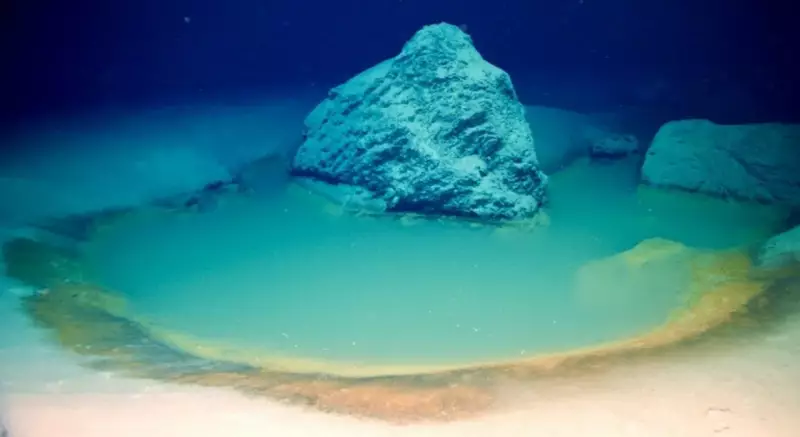
Deep beneath the ocean's surface lie some of the most dangerous environments on Earth. Scientists call them brine pools. Many people know them as underwater lakes or lakes of death. These pockets of water contain such extreme salt concentrations that they form sharp, visible boundaries on the seafloor.
What Makes Brine Pools So Deadly
Most marine animals instinctively avoid these toxic zones. When a fish or crab accidentally slips inside, the extreme salinity immediately disrupts its cells. The animal stops moving and breathing within moments. This rapid death occurs because the sudden difference in salt concentration triggers osmotic shock. Water gets drawn out of the animal's cells almost instantly.
At the same time, these pools contain virtually no oxygen. This prevents normal respiration. Observations from multiple expeditions show that animals entering brine pools get stunned or killed within seconds. Over time, this process creates what researchers describe as underwater graveyards.

The Science Behind These Underwater Lakes
Deep-sea brine pools form when extremely salty water collects in depressions on the ocean floor. The water becomes so dense that it does not mix with the surrounding sea. In the Red Sea, these pools likely originate from the dissolution of mineral deposits. These deposits formed during the Miocene epoch between about 23 million and 5.3 million years ago.
Back then, sea levels were much lower than today. As salt beds dissolve, the resulting brine sinks and settles into basins. This creates isolated lakes within the ocean itself.
The chemistry here is truly extreme. Brine pools can be three to eight times saltier than normal seawater. They are also completely anoxic, meaning they contain no oxygen. The combined effect of salinity, density and chemistry creates a sharp physical boundary between the pool and surrounding water.
This boundary features slow-moving waves in complete darkness. It has a distinct surface that researchers can clearly see during deep-sea explorations.
Where Scientists Find These Rare Formations
Globally, researchers know of only a few dozen brine pools. They exist in just three regions:
- The Gulf of Mexico
- The Mediterranean Sea
- The Red Sea
The deepest known example lies in the Orca Basin in the Gulf of Mexico. It sits about 2,200 metres below sea level. There, a depression roughly 7 by 21 kilometres contains brine with around 300 grams of salt per litre. That's about eight times saltier than the surrounding gulf waters.
Predators That Use Brine as a Weapon
The boundary between normal seawater and brine has become an unexpected hunting ground. During expeditions documented by OceanX, researchers observed shrimp hovering precisely at this interface. These shrimp never cross into the deadly pool. Instead, they wait patiently.
When a fish or crab becomes stunned by the brine and drifts back out, the shrimp dart in immediately. They seize the incapacitated animal and retreat to safety. The brine effectively becomes a weapon. It serves as a natural trap exploited by predators that have learned exactly where safety ends.
Microbial Life Thriving in Extreme Conditions
Despite being lethal to larger animals, brine pools are anything but lifeless. They support dense communities of extremophile microorganisms. These mainly include bacteria and archaea that have adapted to conditions fatal to most life forms.
These remarkable microbes do not rely on oxygen or sunlight. Instead, they draw energy from chemical reactions. These include the oxidation of sulfur compounds or methane. Their cell walls and membranes have special structures. These remain stable in extreme salinity and in the presence of toxic chemicals.
Thick microbial mats often carpet the edges and floors of brine pools. They form the base of a food web that supports specialised animals at the margins.
Sam Purkis, a marine geoscientist at the University of Miami, explains the significance. "At this great depth, there is ordinarily not much life on the seabed," he said. "However, the brine pools are a rich oasis. Thick carpets of microbes support a diverse suite of animals."

Among the most striking observations were fish, shrimp and eels. These animals appear to use the brine itself as part of their hunting strategy. They feed on animals that become incapacitated at the boundary.
Windows to Early Earth and Medical Potential
According to Purkis, these microbial communities hold particular interest. They mirror conditions thought to resemble early Earth. "Our current understanding is that life originated on Earth in the deep sea, almost certainly in anoxic conditions," he explained.
Studying brine pools offers a glimpse into environments where life first appeared. This research could inform the search for life on other water-rich worlds.
Some of these microbes may also have practical value. Scientists have previously isolated molecules with antibacterial and anticancer properties from microorganisms living in brine pools. This raises exciting possibilities for future medical applications derived from these extreme ecosystems.
The Red Sea's Remarkable Concentration
The Red Sea stands out globally for its brine pool concentration. Scientists have identified at least 25 complexes there. This represents more than any other region on Earth.
Until recently, all known Red Sea brine pools were located at least 25 kilometres offshore. That changed with the discovery of the NEOM Brine Pools in the Gulf of Aqaba.
Researchers first reported these pools in June 2022 in Communications Earth & Environment. They found them during a four-week expedition aboard OceanX's research vessel OceanXplorer. Using remotely operated vehicles, the team located the pools at a depth of about 1,770 metres.
Remarkably, these pools sit just two kilometres from the Saudi Arabian coast. This sets a record for proximity to land. The largest pool measures roughly 260 metres in length and 70 metres in width. It covers about 10,000 square metres. Three smaller pools nearby each measure less than 10 square metres.
Their location so close to shore makes them unique biologically, geologically and historically.
Natural Archives Preserved by Salt
The lack of oxygen in brine pools has another fascinating consequence. It preserves sediment layers with unusual clarity. On most seafloors, animals such as worms and shrimp constantly churn the sediment. Scientists call this process bioturbation.
In brine pools, those animals cannot survive. As a result, layers of sediment settle and remain undisturbed for centuries. Core samples taken from the NEOM brine pools provide an unbroken environmental record stretching back more than 1,000 years.
According to Purkis, these cores capture evidence of past rainfall, floods, earthquakes and tsunamis in the Gulf of Aqaba. Analysis suggests that major floods from intense rainfall occur roughly once every 25 years. Tsunamis strike about once every century.
Because the pools lie so close to land, they may also incorporate minerals and material washed in from the coast. This effectively records terrestrial as well as marine events. Researchers describe them as natural time capsules. They preserve a layered history of environmental upheavals in a region now undergoing rapid coastal development.
These findings underscore why brine pools continue to draw scientific attention. They are lethal to most creatures that enter them. Yet they sustain unique ecosystems. They preserve detailed geological records. And they offer a rare window into how life can persist under conditions that once dominated the early Earth.





