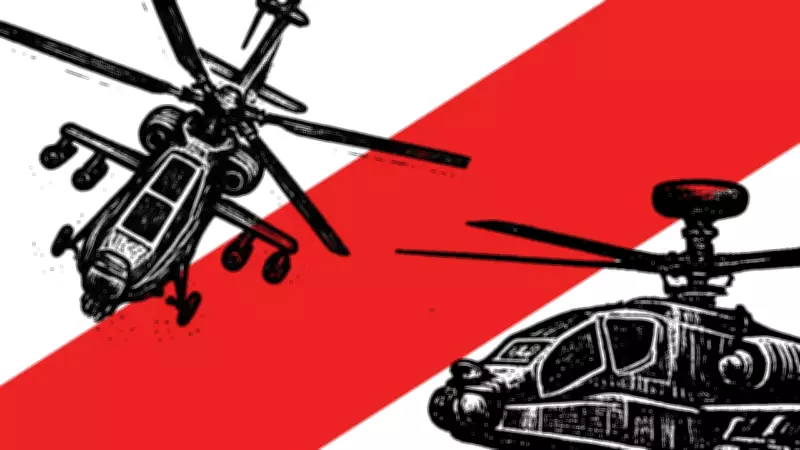
In a deal exceeding USD 198.2 million, the US State Department approved the potential sale of support services and related equipment for Boeing AH-64E Apache attack helicopters to India. The State Department stated that the sale will enhance India's capability to address current and future threats, bolster homeland defense, and deter regional threats.
India's Indigenous LCH Prachand
In April, Chief of Army Staff General Upendra Dwivedi flew a sortie in India's indigenously built Light Combat Helicopter (LCH) 'Prachand', evaluating its performance, agility, and mission readiness. This raises the question: if India has its own attack helicopter, why does it continue to rely on Russian and American counterparts? And how does the Apache compare to the LCH?
Specifications Comparison
According to Hindustan Aeronautics Limited, the Prachand has a two-pilot crew, a maximum take-off weight of 5,800 kg, a maximum speed of 280 km/h, a cruise speed of 260 km/h, a payload-dependent operational range between 550 and 700 km, a climb rate of 12 meters per second, and the world's highest operational ceiling of 6,500 meters.

In contrast, as per Boeing, the twin-seater US-made Boeing AH-64E Apache has a maximum take-off weight of 10,432 kg, a maximum speed of 300 km/h, a cruise speed of 265 km/h, a combat range of 480-500 km, a service ceiling of 6,400 meters, and a climb rate of approximately 14.2 meters per second.
Compared to the Apache, the Prachand offers an almost similar cruise speed, a greater operational ceiling (the highest in the world), and a larger operational range. The Apache excels in terms of double the maximum take-off weight, top speed, and a faster climb rate. However, the specifications of attack helicopters are tailored to their operational requirements.
Different Operational Requirements
According to HAL, the Prachand holds the distinction of being the first attack helicopter to land in Siachen, the world's highest battlefield. It was specially designed following a requirement identified during the Kargil war for a light combat helicopter capable of operating in the tall and harsh Himalayan terrains of Siachen, Ladakh, and Arunachal Pradesh. It weighs just 5.8 tonnes, nearly half the weight of an Apache.
The American counterpart is intended for the flat plains, deserts, and semi-desert areas along India's western and northwestern borders, such as Rajasthan and Punjab. This explains its nearly double maximum take-off weight compared to the LCH. India requires the capabilities of both helicopters for its overall operational needs.
Replacing the Ageing Fleet
The entire air force is undergoing modernization, with ageing fleets being actively replaced. During the induction ceremony of Apache helicopters in 2019, then Air Chief Marshal BS Dhanoa stated, “Apache attack helicopters are being purchased to replace the Mi-35 fleet. Apaches have been an integral part of numerous historic campaigns worldwide. These aircraft have been modified specifically to suit the exacting standards demanded by the IAF.”
Highlighting India's military capabilities, the US State Department said, “India will have no difficulty absorbing these articles and services into its armed forces.”
Regarding the deal, the US State Department added: “This proposed sale will support the foreign policy and national security objectives of the United States by helping to strengthen the U.S.-Indian strategic relationship and to improve the security of a major defense partner, which continues to be an important force for political stability, peace, and economic progress in the Indo-Pacific and South Asia regions.”
Earlier on April 9, the Indian Army demonstrated the combat strength of the AH-64 Apache during a live firing exercise 'Brahmastra' at the Pokhran Firing Range. The demonstration underscored the army's growing focus on high-precision, network-centric warfare.
The Boeing AH-64 Apache is among the most advanced multi-role combat helicopters in the world. It is equipped with a 30 mm chain gun, can carry Hellfire anti-tank missiles and Hydra rockets, and features advanced targeting systems such as the Longbow radar and night-vision sensors. The Apache AH-64E also has the ability to operate in all-weather conditions, including at night, just like the Prachand.