

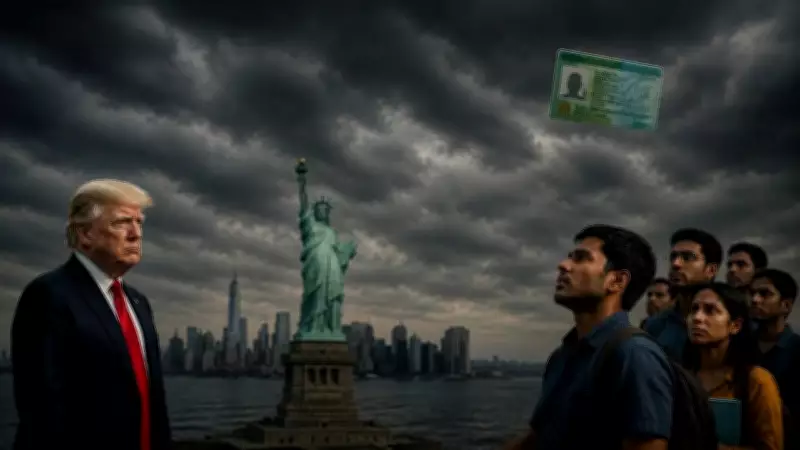
The Donald Trump administration has introduced a new challenge for green card hopefuls in the United States: most immigrants seeking permanent residency must now leave the country and complete the application process from overseas. This policy change is creating anxiety for hundreds of thousands of applicants whose cases are already awaiting approval.
Impact on Indian Nationals
While the exact number of Indians affected remains unclear, Indian nationals constitute one of the largest groups waiting for green cards. A 2022 report by the Cato Institute estimated that the Indian green card backlog stood at 719,737 in the previous year, with waiting periods potentially stretching up to 90 years.
Data from the US Citizenship and Immigration Services (USCIS) indicates that nearly 540,000 family-sponsored green card applications and about 170,000 employment-based applications are currently pending. However, a policy memo issued on May 22 did not clearly state whether the rule applies only to future applicants or also to those whose cases are already in process, according to an ET report.

The Challenge Ahead
Being forced to restart the application process from outside the US could create serious challenges for many applicants, particularly those with families already living in the country and professionals navigating a difficult job market disrupted by artificial intelligence. The requirement may also cause additional delays in processing permanent residency applications.
Shilpa Malik, managing attorney at VisaNation Law Group, noted that the policy memo does not clarify whether the changes apply only to applications filed after May 21 or also extend to cases already submitted. This ambiguity remains one of the biggest unresolved concerns for hundreds of thousands of applicants with pending cases.
Malik added that processing timelines for I-485 applications — the form used for adjustment of status to permanent residency — currently range between roughly 11 and 31.5 months for employment-based categories.
Experts observed that while adjustment of status applications filed through work or student visas have always involved discretionary review, the latest USCIS guidance appears to signal a broader and more aggressive use of that discretion than previously practiced.
Official Statements and Criticism
A USCIS spokesperson told media platform Semafor that applicants who contribute economic value or whose applications are considered in the national interest would still be allowed to continue under the current system. However, the spokesperson did not provide further clarification on implementation.
Marco Rubio, who is currently visiting India on a four-day trip ending May 26, stated on Sunday that the immigration measures were not specifically directed at India but were part of a broader global effort to address the migration crisis in the United States.
The tougher immigration measures, including increased visa rejections and the new requirement to apply for green cards from abroad, have drawn criticism from prominent technology leaders such as Andrew Ng, cofounder of Coursera; Yann LeCun, AI pioneer; and Reid Hoffman, cofounder of LinkedIn.
In a post on X, Andrew Ng described the policy as “a capricious attack on legal immigration,” warning that it would negatively impact families, reduce the number of doctors, teachers, and scientists in the United States, and weaken the country’s competitiveness in artificial intelligence.
Reid Hoffman also criticized the measure on X, calling it damaging for the technology sector, businesses, and the broader US economy. Garry Tan said in a post on X that the policy was misguided and harmful, adding that the United States needs to retain talented individuals who can build future businesses capable of generating employment for millions.
The latest immigration measures are consistent with the Trump administration’s broader scrutiny of skilled foreign workers in the US, including the proposed $100,000 fee for new H-1B visa petitions.






