

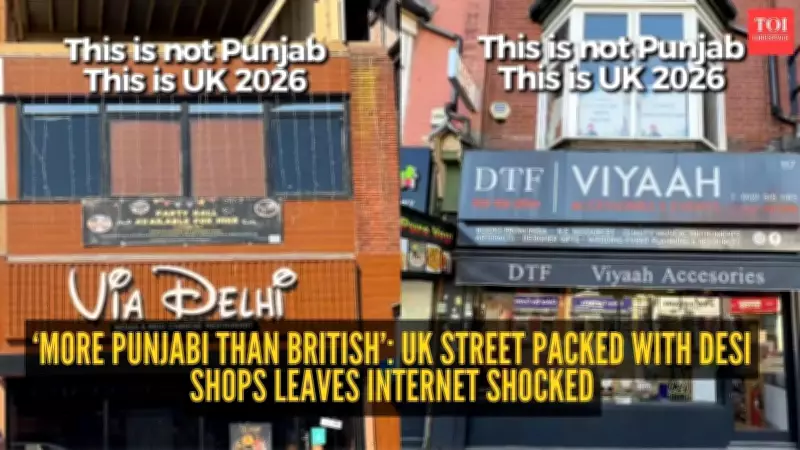
A video shared by an Indian-origin content creator in the United Kingdom has unexpectedly become one of the internet’s latest talking points, with many people online dubbing it “Punjab 2.0.” The now-viral clip showcases a bustling street adorned with Punjabi signboards, Indian clothing shops, desi grocery stores, restaurants, and even artwork featuring the late singer Sidhu Moose Wala. At one point, viewers spotted auto-rickshaws that looked straight out of an Indian city, causing many to do a double take.
Not Your Typical British Street
What truly stunned viewers was that the area did not resemble the typical image many associate with Britain. Instead, the entire locale resembled a lively Punjabi market transplanted overseas. The creator leaned into this reaction with a caption that instantly grabbed attention: “Believe it or not – this is not Punjab, this is the United Kingdom.” The post also clarified that the area was not Southall, the London neighborhood already famous for its large South Asian community, which only piqued viewers’ curiosity further.
Social Media Explosion
Within hours, the video exploded across social media platforms, triggering thousands of comments ranging from hilarious memes to larger debates about migration, identity, and Britain’s colonial history. Many users jokingly called it “reverse colonisation,” with comments flooding in about Punjabis “taking over” parts of the UK and Canada. One user joked that the street looked “more Punjabi than British,” while another sarcastically wrote, “Now Britishers know how it feels.”

A Testament to Cultural Integration
Others saw the viral clip as proof of how deeply South Asian culture has become woven into everyday life abroad. From sweet shops and fabric stores to Punjabi music playing in the background, viewers noted that the street felt almost indistinguishable from parts of Ludhiana or Amritsar. The internet, of course, turned the phenomenon into meme material. One comment read, “You can leave Punjab, but Punjab will follow you everywhere.” Another user joked, “At this point, Punjabis don’t migrate, they duplicate the whole city.”
Deeper Conversations Emerge
Beyond the humour, the video sparked conversations about immigration and the long history of South Asian communities in Britain. Several users pointed out that Punjabi families have lived and built businesses in the UK for generations, especially since the 1960s and 1970s. “We are here because the British were there,” one comment read – a phrase often used in discussions about migration from former British colonies. Some viewers pushed back against negative reactions, reminding others that immigrant-run businesses contribute heavily to local economies. “Those shops are paying taxes and creating jobs too,” one person commented.
Not a New Phenomenon
Others noted that neighbourhoods like these are hardly new. “This has existed for decades, people are only discovering it now because of social media,” another user wrote. Still, the clip struck a chord online because of how dramatically it blurred cultural boundaries. One moment it looked like a British high street, and the next it felt like the middle of Punjab during festival season. That contrast is exactly why the internet cannot stop watching it.






