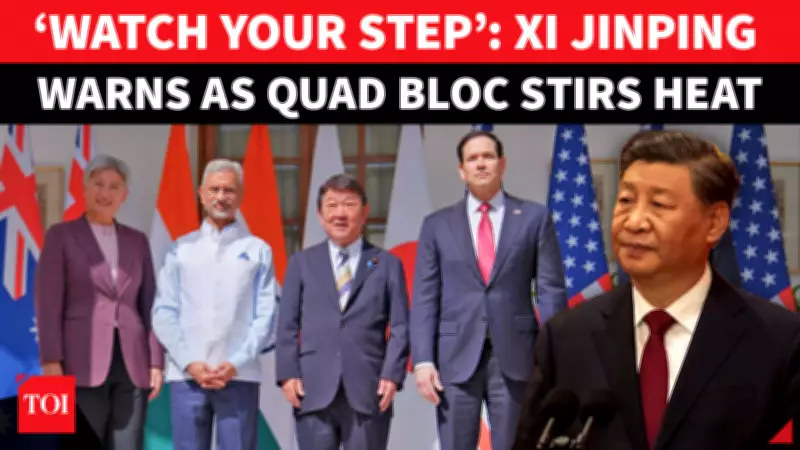
Chinese President Xi Jinping has strongly criticized the Quadrilateral Security Dialogue, commonly known as the Quad, accusing the grouping of engaging in dangerous bloc politics that threaten regional stability. Speaking on the sidelines of a regional summit, Xi stated, 'We do not support any form of exclusive small cliques or actions that fuel bloc confrontation.' His remarks came shortly after the Quad nations—the United States, India, Japan, and Australia—concluded high-level talks in New Delhi, where they announced expanded cooperation on critical minerals, energy security, and maritime surveillance in the Indo-Pacific.
Quad's Expanding Agenda Draws Beijing's Ire
The Quad ministerial meeting, held on May 26, 2026, saw the four nations pledge to enhance joint efforts in securing supply chains for critical minerals, boosting energy security, and increasing maritime domain awareness in the Indo-Pacific region. In a joint statement, the Quad ministers issued strong warnings against 'coercion and threats to regional stability,' a clear reference to China's assertive actions in the South China Sea and the Taiwan Strait. Beijing, however, views the Quad as a US-led attempt to contain its rise and undermine its legitimate interests.
China's Counter-Narrative
Chinese Foreign Ministry spokesperson Wang Wenbin reinforced Xi's stance, stating that 'the Quad is an exclusive clique that seeks to create division and confrontation in the region.' He urged the Quad members to abandon Cold War-era thinking and focus on genuine cooperation that benefits all countries in the Indo-Pacific. China has consistently opposed any multilateral security arrangement that excludes it, promoting instead its own vision of regional order through initiatives like the Belt and Road Initiative and the Regional Comprehensive Economic Partnership.

The Quad's recent moves come amid heightened tensions in the region, including China's increased military activities around Taiwan and its disputes with several Southeast Asian nations in the South China Sea. The United States has been strengthening its alliances in the region, viewing the Quad as a key pillar of its Indo-Pacific strategy. India, Japan, and Australia have also deepened their security cooperation with Washington, while maintaining economic ties with China.
Regional Reactions and Implications
Analysts suggest that Xi's strong words reflect Beijing's growing unease with the Quad's expanding scope. 'China sees the Quad as a direct challenge to its influence and is determined to counter it through diplomatic and military means,' said Dr. Li Ming, a professor of international relations at Peking University. The Quad nations, however, maintain that their cooperation is not directed against any country but aims to ensure a free and open Indo-Pacific. The US State Department reiterated that 'the Quad is a grouping of like-minded democracies committed to upholding international law and norms.'
Meanwhile, other regional players have adopted a cautious stance. ASEAN countries, many of which have close economic ties with China, have refrained from taking sides. The Quad's focus on critical minerals is particularly significant, as China dominates the global supply chain for rare earth elements and other strategic resources. By diversifying sources and investing in domestic processing, the Quad aims to reduce dependency on Beijing.
As the geopolitical rivalry intensifies, the risk of miscalculation and conflict remains high. Xi's warning against 'dangerous bloc politics' is likely to resonate with countries wary of being caught in the crossfire between the US and China. The coming months will test whether the Quad can maintain its momentum without provoking a deeper confrontation with Beijing.