

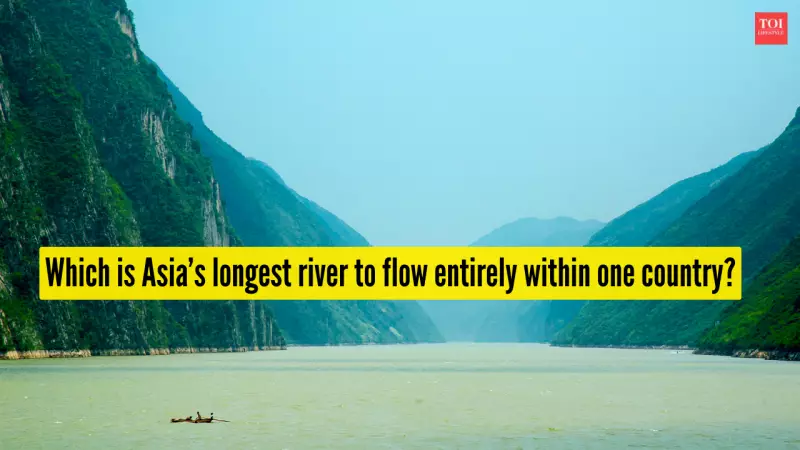
The Yangtze River: China's Timeless Civilizational Artery
For countless centuries, rivers have fundamentally shaped human civilizations across the globe. These powerful waterways have carved majestic mountains, nourished fertile plains, created natural boundaries between regions, and determined the very locations where great cities would emerge and international trade would thrive. Among these influential rivers, one stands out for its profound and continuous impact on a single nation: the Yangtze River in China.
A River of Historical Significance and Geographical Uniqueness
This mighty river existed long before modern bridges spanned its considerable width, before travelers relied on ferries for crossing, and before trains made scheduled stops along its banks. The Yangtze has silently witnessed the dramatic rise and fall of numerous dynasties, carried precious goods that powered ancient and modern economies, and sustained unique ecosystems found nowhere else on our planet. Today, it continues to serve as an indispensable backbone for industry, transportation, and energy production, solidifying its status as one of the world's most influential rivers.
Flowing entirely within China's borders for approximately 6,300 kilometers, the Yangtze holds the distinction of being not only Asia's longest river but also one of the most significant river systems worldwide. This geographical fact sets it apart from other great rivers like the Nile, Amazon, or Danube, which typically flow through multiple countries or serve as international borders. The Yangtze's complete containment within a single nation makes it geographically unique among the world's major waterways.

Flow Characteristics and Monitoring Systems
Originating from the majestic Tibetan Plateau and eventually emptying into the East China Sea near Shanghai, the Yangtze maintains its status as a completely domestic waterway. Regarding discharge volume, it ranks as the fifth-largest river globally. Between 1955 and 2021, its estuary maintained an estimated average annual flow rate of approximately 995.8 cubic kilometers per year, equivalent to about 31,550 cubic meters per second. The river's flow is carefully monitored at Datong, which serves as the final gauging station before the water reaches the estuary, ensuring regular observation and data collection.
Historical Barriers and Modern Connectivity
For an astonishing 4,000 years, the Yangtze River functioned as a major geographical barrier separating northern and southern China. Before the mid-20th century, virtually no bridges crossed the river between Yibin and Shanghai, with only a few exceptions in Sichuan's mountainous regions. This made crossing the great Yangtze exceptionally challenging, though determined travelers used ferries when absolutely necessary. Train passengers during this era would disembark, cross the river via steam ferry, and resume their journey from the opposite bank.
This transportation landscape transformed dramatically after 1949. The pioneering Wuhan Yangtze River Bridge, completed with assistance from Soviet specialists and opened to traffic in 1957, became the first bridge constructed over this formidable river. This engineering milestone was followed by crucial crossings in Chongqing and Nanjing, effectively transforming the Yangtze from a historical barrier into what we now recognize as a "backbone" of national communication and connectivity.
Ecological Treasures and Environmental Pressures
The Yangtze basin supports an expansive array of ecosystems that harbor countless endemic species, including the Chinese alligator and the finless porpoise. Tragically, it also served as the final dwelling place for now-extinct species like the Yangtze river dolphin (baiji) and the Chinese paddlefish. Rapid industrialization has exacted a heavy toll on the river's health. Industrial pollution, agricultural runoff, plastic contamination, siltation, and widespread wetland loss have collectively degraded water quality while simultaneously increasing flood risks.
Despite these challenges, conservation efforts have established protected zones along certain river sections. Notably, stretches of the upper reaches form part of the Three Parallel Rivers of Yunnan Protected Areas, which has earned designation as a UNESCO World Heritage Site, offering hope for preservation.

Economic Powerhouse and Cultural Lifeline
Few rivers worldwide have contributed more substantially to molding a civilization than the Yangtze has shaped China. For millennia, it has nurtured agricultural irrigation, facilitated transportation, enabled trade, supported sanitation systems, and powered industrial development. In contemporary times, the Yangtze River Delta alone encompasses approximately one-fifth of China's total economic output, dramatically highlighting the river's ongoing economic significance.
The river is also home to the world's largest hydroelectric power station at the Three Gorges Dam. Beyond electricity generation, this massive infrastructure project serves as a crucial hub for flood control and improved navigation, though it has simultaneously raised legitimate concerns about environmental impacts and social consequences for displaced communities.
The Yangtze River stands as a testament to nature's power to shape human destiny while reminding us of our responsibility to protect these vital waterways for future generations.





