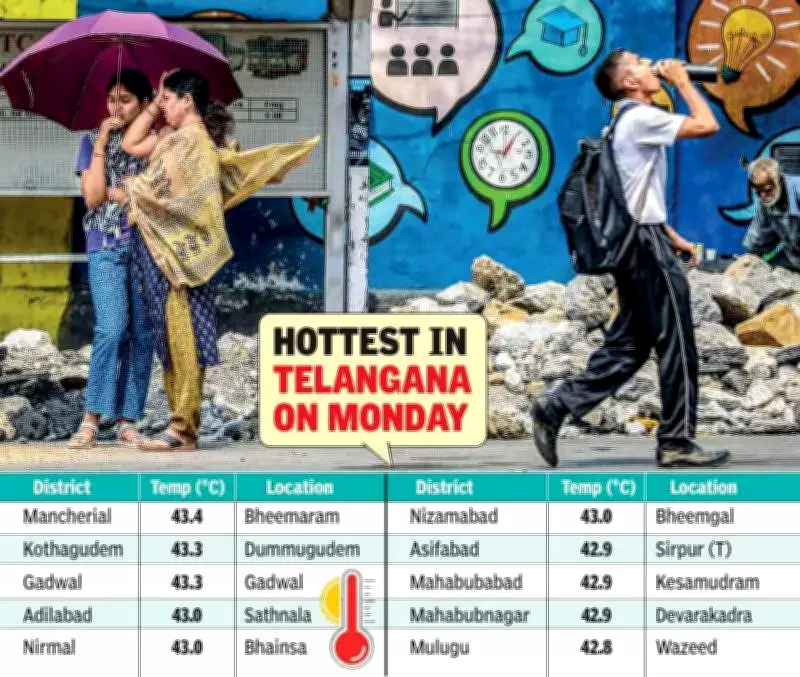
Adilabad Emerges as One of the World's Hottest Cities, Highlighting Broader Heatwave Pattern
Adilabad district in Telangana has firmly established itself as one of the globe's hottest urban areas, consistently appearing in the top 100 list compiled by Eldorado Weather, a prominent United States-based daily weather tracking platform. This alarming trend underscores a severe and persistent heatwave affecting central India, with multiple cities from the region featuring prominently on the same international ranking.
Record Temperatures and Global Ranking
On a recent Monday, Adilabad recorded an average temperature of 43.3 degrees Celsius, securing the 14th position globally. This placed it merely about 2 degrees Celsius lower than Akola in Maharashtra, which topped the worldwide chart at a scorching 45 degrees Celsius. The list of Indian cities experiencing extreme heat is extensive and concerning, including Wardha and Nagpur (Sonegaon) in Maharashtra, Prayagraj in Uttar Pradesh, and Rajnandgaon in Chhattisgarh. This collective presence vividly illustrates a widespread and intense heatwave pattern gripping central parts of the country.
Expert Analysis of Climatic Factors
Meteorological experts assert that Adilabad's frequent appearance on such lists is not an anomaly. Situated in northern Telangana and bordering the historically heat-prone Vidarbha region, the district is directly exposed to dry, hot winds sweeping in from central India. Dharma Raju, a scientist at the India Meteorological Department in Hyderabad, provided detailed insights into the contributing factors.

"These winds, combined with critically low humidity levels, sparse vegetation, and significantly delayed pre-monsoon showers, are collectively pushing temperatures to unprecedented highs," explained Raju. He further elaborated that the region falls within a designated heat core area. "Northerly winds are currently prevailing, and they are exceptionally dry in nature. The complete absence of cloud cover and any meaningful rainfall further intensifies and sustains the extreme heat conditions," he added.
Environmental Degradation and Urban Heat Burden
Compounding the natural climatic challenges are significant environmental changes. Official data reveals that Telangana's forest cover has experienced a marginal but impactful decline, reducing from 18,561.98 square kilometers in 2021 to 18,456.11 square kilometers in 2023. Notable reductions were recorded in districts including Adilabad, Bhadradri Kothagudem, Kumuram Bheem Asifabad, and Nirmal.
YV Rama Rao, a senior weather researcher at the Telangana Development Planning Society, emphasized the consequences. "Even relatively small losses in green cover can substantially reduce natural cooling mechanisms and raise local ambient temperatures. When this deforestation is combined with the overarching effects of global climate change, it significantly increases both the frequency and the intensity of heatwaves in the Adilabad region," stated Rao. He noted that Talamadugu mandal in Adilabad recorded the district's peak temperature at 44.5 degrees Celsius on the same Monday, though he mentioned that unseasonal rainfall might offer a temporary, slight dip in the extreme heat.
Urban areas within the region are facing an additional and growing heat burden. Locations such as Kothapet in the city, which have intermittently appeared on the global hot list with temperatures ranging between 39 and 41 degrees Celsius, are experiencing rising heat due to rapid and often unplanned urbanization.
G Sailu, an urban biodiversity researcher, explained the local dynamics. "The Kothapet belt, situated along the Musi River, behaves like a natural basin. It effectively traps and retains heat, creating a local hotspot. Critically low groundwater levels exacerbate the situation, as groundwater typically plays a vital role in regulating land surface temperatures," said Sailu. He highlighted that water levels in nearby areas had plummeted to below 10 meters as recently as last May.
Sailu further pointed out that dense construction projects, persistent traffic congestion, and continuously shrinking green spaces are actively disrupting the local microclimate, making urban areas increasingly inhospitable during summer months.

A Warning of a Larger Trend
Experts are issuing strong cautions that such extreme temperature events are part of a larger, disturbing trend linked to human activity and environmental mismanagement. Anjal Prakash, a researcher at the Bharti Institute of Public Policy, Indian School of Business, provided a sobering outlook.
"Climate change, tightly coupled with rapid and often unsustainable land-use changes, is dramatically increasing the likelihood that more districts across Telangana and beyond—such as Nizamabad, Mahabubnagar, and Medak—will begin to regularly appear among the world's hottest locations. This is especially probable during the peak pre-monsoon months, which are becoming increasingly severe," warned Prakash. His statement underscores the urgent need for integrated climate adaptation and urban planning strategies to mitigate the growing public health and environmental risks posed by these intensifying heatwaves.