

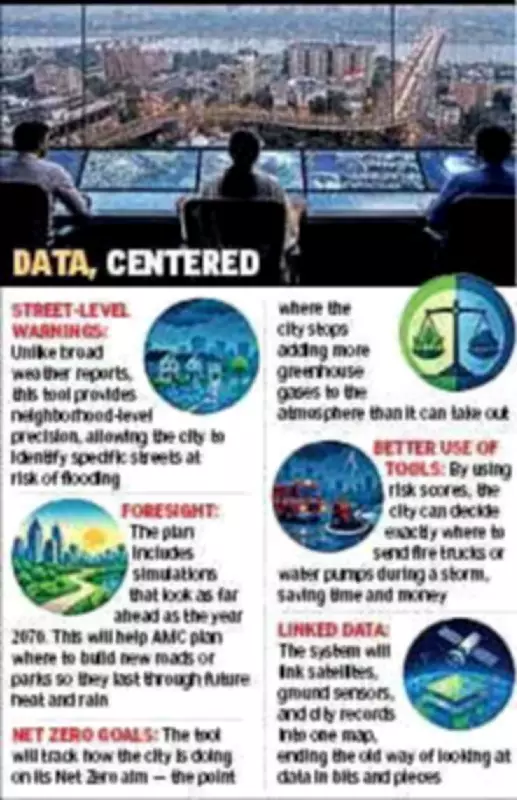
The Ahmedabad Municipal Corporation (AMC) is establishing a sophisticated, artificial intelligence (AI)-driven dashboard designed to forecast and monitor heatwaves, floods, and other climate-related emergencies. This initiative, spearheaded by Smart City Ahmedabad Development Limited (SCADL), signifies a strategic shift from reactive disaster response to proactive prevention.
Unified Data for Proactive Management
The city has issued a “call for interest” as an initial step to identify firms possessing the requisite expertise. Currently, Ahmedabad’s data is described by officials as “fragmented,” with information on rainfall, air quality, and health dispersed across various departments and databases. “This fragmentation hampers the AMC’s ability to anticipate crises. The new system will consolidate all this information into a central ‘brain’ known as the Ahmedabad Urban Observatory,” explained a senior AMC official involved in the project.
Forecasting Engine and Machine Learning
A core component of the plan is a forecasting engine that employs machine learning—a technique where computers learn from historical data to identify patterns—alongside established meteorological principles to predict weather conditions. “The goal is to provide a 72-hour advance warning for storms or heatwaves at the municipal ward level, enabling targeted alerts for specific neighborhoods rather than blanket citywide notifications,” the official stated.

Flood and Heat Monitoring
To combat urban flooding, the system will utilize three-dimensional ground maps to delineate the city’s high and low-lying areas. This will assist civic authorities in visualizing potential water accumulation during heavy rainfall. For heat-related risks, the tool will integrate satellite data and ground sensors—interconnected devices that monitor real-time heat levels—to map heat stress across the city. “This information will facilitate the deployment of aid to the most vulnerable populations,” the official added.
Air Quality Tracking
To issue warnings for poor air quality days, the system will monitor the Air Quality Index (AQI), a numerical scale indicating air cleanliness. It will incorporate dispersion models—mathematical simulations that illustrate how pollutants like smoke or dust spread via wind patterns.
Unified Dashboard and Alerts
All risk indicators will be displayed on a single dashboard accessible to AMC personnel. The system includes a chat interface supporting both English and Gujarati languages. “When a threat exceeds a predefined threshold, the system will automatically dispatch text messages or WhatsApp alerts to relevant authorities, following standard operating procedures—the city’s rapid response protocol,” according to AMC’s ‘AI Based Climate Resilience Solution’ document.






