

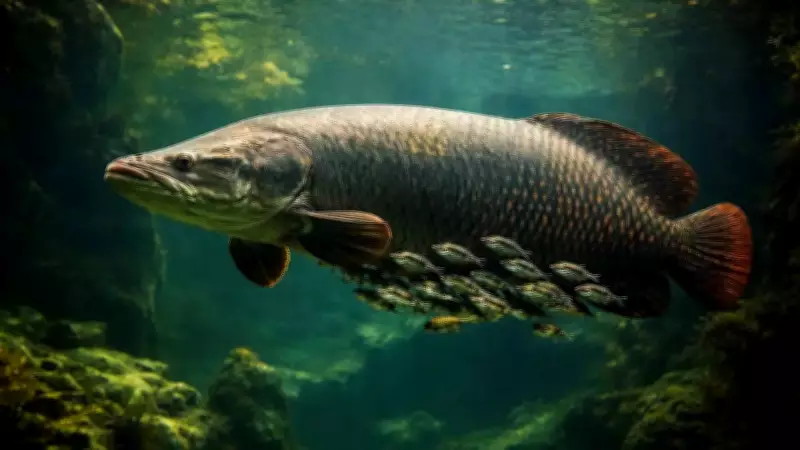
The Amazon's Prehistoric Giant: The Arapaima Fish
Deep within the expansive rivers and flooded forests of the Amazon Basin resides a fish that seems to have stepped out of a prehistoric era, both in its immense size and ancient appearance. Known as the arapaima, or locally as the "pirarucu," this colossal creature ranks among the largest freshwater fish on Earth. It can grow to nearly three meters in length and weigh up to 200 kilograms, dominating the aquatic realms of the Amazon with its formidable presence.
More Than Just Size: The Arapaima's Unique Characteristics
However, it is not merely the arapaima's impressive dimensions that captivate scientists and fishermen alike. This ancient species, belonging to the bony-tongued fish family, has thrived for millions of years, adorned with large, armor-like scales so robust they can repel attacks from piranhas. Its streamlined body and powerful tail make it an adept hunter in the slow-moving Amazon waters. Additionally, the arapaima possesses a remarkable adaptation: it surfaces to breathe air, thanks to a swim bladder that functions similarly to lungs, enabling survival in the oxygen-depleted environments of the river.
The Astonishing 'Milk' Secretion for Parental Care
The most surprising aspect of the arapaima's behavior lies in its method of nurturing offspring. After eggs hatch, the young fish cluster closely around the head of a parent, typically the male. Researchers have identified specialized glands on the adult's head that secrete a nutrient-rich fluid, often referred to as "arapaima milk." This substance, while distinct from mammalian milk, is believed to provide essential nourishment to the juveniles. This phenomenon is exceptionally rare in the fish world, where such parental care is typically associated only with mammals and birds, making it a subject of intense scientific fascination.

Why Young Arapaima Stay Close to Their Parents
In their natural habitat, newly hatched arapaima form tight groups near their parent, aided by dark coloration that offers camouflage. The parent releases pheromones to keep the young cohesive and guide them to safe areas abundant with plankton and other food sources. This extended parental care, unusual for most fish species, significantly boosts the survival rates of the young in predator-rich Amazon waters. As they grow, the juveniles gradually transition to independent feeding while still under parental protection.
Scientific Insights into the Milk-Like Secretion
A study published in PLOS ONE and listed in the U.S. National Library of Medicine database, titled "Comparative proteome and peptidome analysis of the cephalic fluid secreted by Arapaima gigas during and outside parental care," analyzed this cephalic fluid. It revealed hundreds of biological compounds, proteins, and peptides linked to growth and immune functions. The secretion likely aids in rapid development and disease resistance during early life stages, and may also serve as a communication tool to maintain group cohesion in the murky river environment. While the exact purpose remains under investigation, it underscores a complex form of parental care rarely observed in fish.
A Reminder of Nature's Endless Surprises
This discovery emphasizes how much remains unknown about river ecosystems worldwide. The arapaima, already renowned for its size and ancient lineage, now reveals a new layer of biological complexity through its milk-like secretion. In the Amazon, survival often hinges on unique adaptations, and even a massive fish like the arapaima has evolved innovative strategies to safeguard its progeny. To the scientific community, the arapaima symbolizes the unexpected ways evolution fosters offspring protection, reminding us that nature continually holds surprises waiting to be uncovered.






