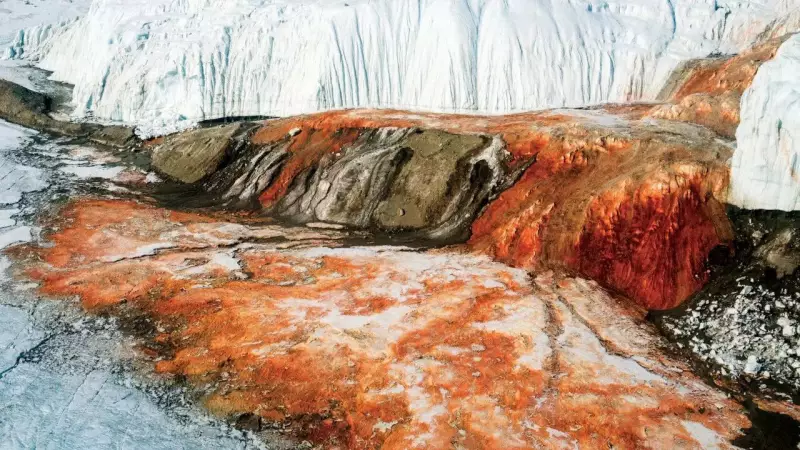
Antarctica stands as one of Earth's most extreme and hostile environments, where life battles against freezing temperatures and relentless winds. Yet, amidst this frozen wilderness lies a natural spectacle that defies expectations: Blood Falls. This remarkable waterfall cascades from the Taylor Glacier into Lake Bonney, its deep reddish hue creating an eerie, blood-like appearance against the stark white ice.
The Crimson Enigma of McMurdo Dry Valleys
Blood Falls is located in Antarctica's McMurdo Dry Valleys, renowned as one of the world's driest deserts. The waterfall emerges from the terminus of the Taylor Glacier, flowing slowly into Lake Bonney at a height equivalent to approximately five stories. Its presence in such an arid, icy region is extraordinary, contrasting sharply with typical rivers that teem with life and abundant water flow.
Unraveling the Red Mystery
Despite its ominous appearance, Blood Falls does not consist of blood. The striking red coloration originates from iron-rich brine that seeps from subglacial water trapped beneath the Taylor Glacier. This phenomenon dates back about two million years when rising sea levels formed a saltwater lake in East Antarctica. Subsequent glaciation covered the lake with ice, sealing it from the atmosphere.

The trapped water became highly saline—three times saltier than seawater—and remained liquid under 400 meters of ice due to its salt content. When this iron-laden water flows out and contacts atmospheric oxygen, it oxidizes, producing the distinctive crimson stain on the ice surface.
Ancient Life Beneath the Ice
Blood Falls is sustained by a subglacial lake that has been isolated from sunlight and the atmosphere for millions of years. This ancient reservoir supports unique microbial life adapted to extreme conditions, including absence of oxygen and light. Microorganisms here derive energy from sulphates, utilizing iron in a chemical recycling process that sustains their existence.
Sustaining the Flow
The waterfall is fed by a network of subglacial rivers transporting highly saline water. High salt content lowers the freezing point, allowing the iron-rich brine to flow despite Antarctica's frigid climate. As it moves through glacial cracks, the brine slightly melts surrounding ice through latent heat, maintaining the waterfall's steady flow. Iron concentration increases near the surface, intensifying the red hue as water enters Lake Bonney.
Scientific Insights from Extreme Environments
Beyond its dramatic color, Blood Falls offers scientists a rare glimpse into life thriving under extreme duress. The microorganisms here resemble those found near deep-sea hydrothermal vents, capable of surviving high salinity and anoxic conditions. Studying these life forms provides clues about Earth's primordial past and potential for life on other planets with similar harsh environments.
This natural wonder exemplifies life's resilience and the intricate geological processes shaping our planet, making Blood Falls one of Antarctica's most captivating and scientifically valuable phenomena.