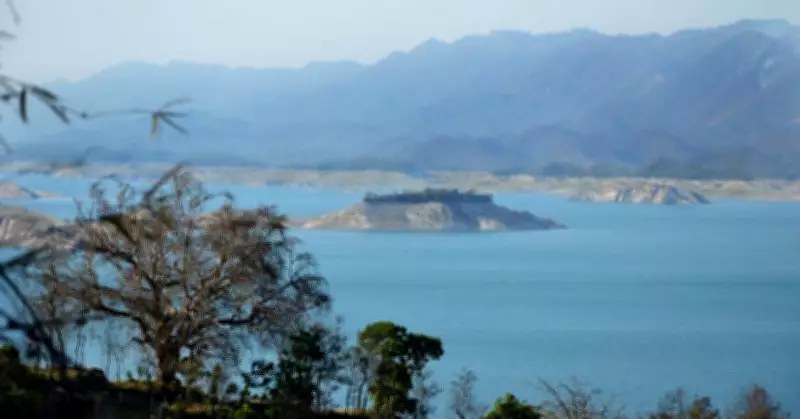
The Sutlej basin is experiencing one of its weakest snowmelt seasons in recent years, with the Bhakra reservoir receiving barely half the water it did during the corresponding period last year. This sharp decline has raised concerns over water availability for irrigation, hydropower generation, and ecological flows if the southwest monsoon fails to deliver substantial rainfall in the coming weeks.
Inflow Data Reveals Alarming Drop
According to the latest reservoir data released on Saturday, the inflow into Bhakra was only 24,380 cusecs, compared to 42,249 cusecs on the same day last year and the long-term average of 41,582 cusecs. This represents a decline of nearly 42% from last year and 41% below the seasonal average. The cumulative inflow figures are even more striking: between May 21 and June 27, Bhakra received only 612,850 cusecs, against 1,148,282 cusecs during the same period last year and a long-term average of 1,173,096 cusecs. In volumetric terms, cumulative inflows stood at 1.50 billion cubic metres (BCM), almost half of last year's 2.81 BCM and well below the average of 2.87 BCM.
Reservoir Level Declines as Demand Exceeds Inflow
The Bhakra Beas Management Board (BBMB) is releasing 29,694 cusecs daily on demand from partner states, exceeding inflows by more than 5,300 cusecs to meet irrigation requirements following the commencement of the paddy season in Punjab and Haryana. As a result, the reservoir level declined by 0.73 feet during the day to 1,559.22 feet, with Bhakra currently holding 1.32 BCM, equivalent to 23% of its live storage capacity.

Weak Snowfall and Delayed Melt Blamed
Hydrological experts attribute the weak inflows primarily to significantly lower snowfall in the upper Sutlej catchment spread across Himachal Pradesh and the Tibetan Plateau, coupled with delayed snowmelt caused by prolonged western disturbances during late spring and early summer. According to sources monitoring the basin, the average snowfall in the Sutlej catchment is around 4 BCM, but the region received only about 2.2 BCM during the past winter. This substantially reduced the volume of snow available for melting during summer. In addition, repeated western disturbances kept temperatures in the higher reaches unusually low. While substantial snowmelt generally begins when temperatures rise to around 6–8 degrees Celsius, average temperatures in the upper catchments remained close to 4 degrees Celsius through much of the season, delaying the melting process.
Neighbouring Basins Also Affected
The situation is equally concerning across neighbouring river basins. Pong Dam on the Beas recorded inflows of only 3,611 cusecs on June 27th compared with 40,748 cusecs on the corresponding day last year and a long-term average of 13,179 cusecs. Cumulative inflows into Pong since May 21 stood at only 96,856 cusecs, less than one-third of last year's 307,054 cusecs. Similarly, Pandoh Dam received 9,463 cusecs on June 27th, sharply lower than 21,679 cusecs last year, while the Ranjit Sagar Dam on the Ravi recorded inflows of just 3,380 cusecs, compared with 11,541 cusecs on the corresponding date in 2025.
Monsoon Performance Critical for Water Security
Water experts warn that the present trend reflects an unusually poor snowmelt season across the western Himalayas and underlines the increasing dependence of northern India's water security on the southwest monsoon. If July and August fail to deliver above-normal rainfall, reservoir storage, canal supplies, hydropower generation, and downstream ecological flows in the Sutlej could come under sustained pressure. The performance of the monsoon is now likely to determine the water outlook for the remainder of the irrigation season across much of north India.