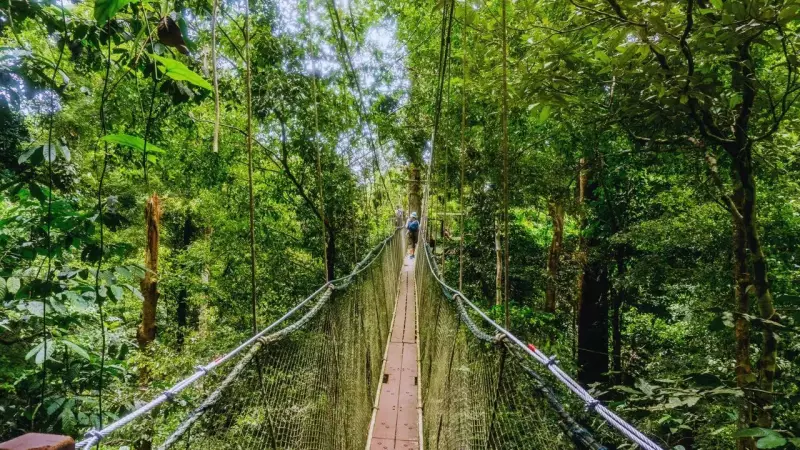
Deep within the lush, emerald heart of Borneo lies a realm where danger often wears a deceptively beautiful face. In one of Earth's oldest surviving tropical rainforests, some of the most remarkable hunters are not animals with sharp teeth or claws, but plants that wait patiently in the soil with open, inviting mouths. This is a world where the traditional food chain is turned completely upside down.
The Rainforests of Borneo: A Land of Extraordinary Flora
Welcome to the rainforests of Borneo, a region celebrated globally for its iconic orangutans, vibrant hornbills, and towering dipterocarp trees. Yet, beyond these famous inhabitants, this jungle harbors some of the planet's most extraordinary carnivorous plants. Here, vegetation does not merely photosynthesize and bloom; it actively traps, digests, and feeds on insects, spiders, and occasionally even small vertebrates. The forest itself seems to teach plants how to hunt.
Borneo's forests, spanning Malaysia, Indonesia, and Brunei, rank among the richest ecosystems on Earth. However, beneath their verdant beauty lies a challenging reality: the soil across much of the island is notably nutrient-poor, particularly deficient in essential elements like nitrogen and phosphorus. To thrive in such harsh conditions, certain plant species have evolved an ingenious solution—they supplement their diet with meat.

The Undisputed Stars: Borneo's Pitcher Plants
The true celebrities of this carnivorous world are the island's renowned pitcher plants, scientifically known as Nepenthes. Borneo boasts more Nepenthes species than any other location on the planet, with many found exclusively here. These plants produce elegantly curved pitchers, ranging from teacup-sized vessels to containers large enough to hold liters of liquid. Their rims are slick with sweet nectar, luring unsuspecting insects inside. Once an insect enters, downward-pointing hairs and slippery sides make escape impossible. Enzymes then break down the prey, allowing the plant to absorb vital nutrients.
One of the most fascinating species is Nepenthes rajah, which thrives on the slopes of Mount Kinabalu in Sabah. This giant pitcher plant can trap not only insects but also frogs, lizards, and occasionally small rodents. Nearby, Nepenthes lowii has evolved pitchers that collect nutrients not from insects, but from the droppings of tree shrews that feed on its nectar.
Walking through Borneo's mossy highland forests, travelers often encounter these strange botanical traps nestled beside trails or dangling from branches. They serve as silent reminders that in this jungle, even the most delicate flowers can be formidable predators.
A Rainforest Older Than the Amazon
Part of what makes Borneo's carnivorous plants so exceptional is the immense age of their habitat. The island's rainforests are estimated to be over 130 million years old, predating even the Amazon. Over this vast timespan, isolation and challenging conditions have driven the evolution of uniquely creative species.
In the cloud forests of Mount Kinabalu and the Crocker Range, orchids bloom around moss-covered trunks, pitcher plants cling to thin soil on ridges, and the air is so humid that every leaf seems optimized for survival—some to capture sunlight, others to capture prey. For visitors, encountering these plants feels like stepping into a living natural history museum where evolution continues quietly at the forest floor.
Global Carnivorous Plant Habitats
While Borneo presents the most spectacular stage for carnivorous plants, it is far from the only one. Across the globe, in swamps, heathlands, and rain-soaked forests, similar botanical hunters have evolved wherever nutrients are scarce.
In the southeastern United States, the wetlands of Florida, Georgia, and the Carolinas are home to the famous Venus flytrap (Dionaea muscipula), perhaps the most well-known carnivorous plant. Its leaves snap shut in a split second when triggered by an insect. Nearby, colorful sundews and tall American pitcher plants form carnivorous gardens in quiet bogs.

In the misty highlands of Madagascar, unique Nepenthes species grow on rocky slopes, while in the tropical forests of Sumatra and the Philippines, pitcher plants hang like lanterns from tree branches—some adapted to catch ants, others to collect rainwater and debris.
Closer to home, India's Western Ghats support sundews (Drosera) and bladderworts (Utricularia) in monsoon-fed plateaus and wetlands. These miniature predators capture insects and microorganisms, thriving briefly during the rainy season before going dormant.
Even in temperate Europe, carnivorous plants flourish in quiet peat bogs, where butterworts and bladderworts feed unobtrusively in pools and wetlands.
The Deeper Significance of Carnivorous Plants
For travelers and nature enthusiasts, the search for these plants is more than mere entertainment. It is a discovery of how interconnected and creatively adaptive nature can be, revealing that even the most fragile-looking flower may conceal a dangerous secret.
Ultimately, the rainforests of Borneo offer far more than wildlife encounters and jungle treks. They present a world where the food chain operates as a two-way street, where silence often signals danger, and where some of the most intriguing predators are those that never move from their rooted positions.