

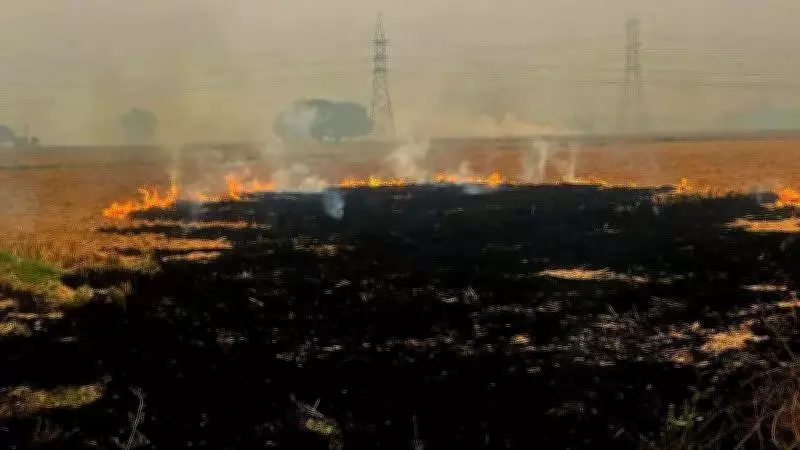
Bathinda: In a concerted effort to tackle the persistent issue of paddy stubble burning, the Commission for Air Quality Management (CAQM) has issued stringent directives to the states of Punjab, Haryana, and the National Capital Region (NCR) areas of Uttar Pradesh. The commission has mandated a comprehensive mapping of every farm and the assignment of nodal officers to monitor crop residue management practices.
Nodal Officer Deployment and Monitoring
Under the new action plan, each nodal officer will be responsible for monitoring a maximum of 100 farmers. However, in hotspot villages identified as prone to stubble burning, the ratio will be stricter, with one officer overseeing only 50 farmers. These instructions were communicated during a virtual meeting held on Friday under the provisions of Section 12 of the Commission for Air Quality Management in NCR and Adjoining Areas Act, 2021.
Farm Mapping and Stubble Management Modes
The states have been directed to prepare village-wise maps of all farms, detailing the proposed method of stubble management. This includes crop diversification, in-situ management (incorporating stubble into the soil), ex-situ management (using stubble for other purposes), and fodder use. The mapping aims to ensure that every farm has a clear plan for residue management, thereby reducing the incidence of burning.

Intensified Patrolling and Satellite Monitoring
To counter the practice of nighttime stubble burning, which often evades satellite detection, the CAQM has instructed states to intensify patrolling during late evening hours. The commission emphasized that some farmers resort to burning after dark to avoid being caught, necessitating enhanced vigilance.
Equipment Review and Procurement
States have been asked to conduct a comprehensive review of crop residue management (CRM) machines currently available. Outdated and non-functional equipment must be discarded, and fresh procurement should be completed by August 2026. This move aims to ensure that modern, efficient machinery is accessible to farmers for managing stubble effectively.
Custom Hiring Centres and Parali Protection Force
The commission has proposed the establishment of custom hiring centres to provide small and marginal farmers with rent-free access to CRM machines. Additionally, a dedicated 'Parali Protection Force' is to be created at the district and block levels, comprising officials from the police, agriculture, and administrative departments. This force will monitor and prevent incidents of stubble burning through regular patrols and inspections.
Web-Based Dashboards for Real-Time Monitoring
States have been directed to develop web-based dashboards for real-time, district-wise monitoring of crop residue management. These dashboards will track key parameters such as crop area, residue generation, machinery deployment, and enforcement actions. The goal is to enable swift response and data-driven decision-making to curb stubble burning.
Strict Enforcement and Penalties
The CAQM has stressed the importance of strict enforcement measures. Farmers found burning stubble will face red entries in land records, which can affect their access to credit and other benefits. Additionally, environmental compensation will be recovered from violators. States are required to submit monthly progress reports to the commission detailing the implementation of the action plan and any enforcement actions taken.
These comprehensive measures reflect the commission's determination to address air pollution caused by stubble burning, a major contributor to the deteriorating air quality in the NCR region during the post-harvest season.






