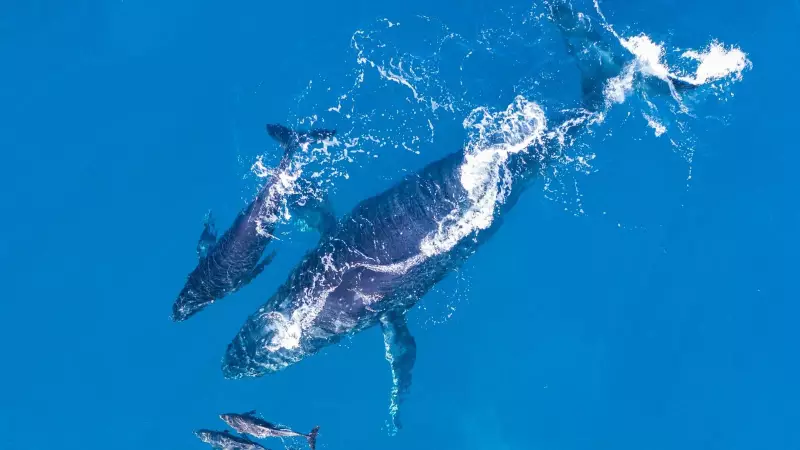
In a groundbreaking study, scientists have for the first time detected a deadly and highly infectious virus in whales within the Arctic Circle. The discovery was made using an innovative and non-invasive method: drones that collected samples from the "blow" or breath exhaled by whales.
Pioneering Drone Research Uncovers Hidden Threat
The research, led by veterinarian Helena Costa of Nord University, was published in mid-December in the journal BMC Veterinary Research. Between 2016 and 2025, the team collected more than 50 blow samples from humpback, sperm, and fin whales. Drones equipped with petri dishes were flown above and behind the whales' blowholes to capture the expelled air.
"It's a little bit crazy that you can collect air from a whale and actually detect something," Costa remarked. This method is a significant advance over the traditional technique of taking skin biopsies, which leaves a small wound on the animal.

The samples were tested for four pathogens, and the results confirmed the presence of cetacean morbillivirus in northern ecosystems. "It has never been reported in that area before," stated Costa, though she added, "We kind of expected that some of the species that migrate would bring it in."
Understanding the Virus and Its Global Impact
Cetacean morbillivirus is a serious threat to porpoises, dolphins, whales, and other marine mammals worldwide. The virus attacks the respiratory and neurological systems and has been responsible for several major outbreaks, particularly in the North Atlantic and the Mediterranean, leading to mass strandings and deaths.
The virus spreads through:
- Direct contact between animals
- Respiratory droplets
While not always fatal, and some infected animals show no symptoms, its detection in the Arctic is a major concern. The study suggests the previous lack of reported cases likely reflected a gap in surveillance, not the actual absence of the virus.
A New Era for Whale Health Monitoring
The research team followed humpback whale migration, collecting samples from groups in northern Norway, Iceland, and Cape Verde off West Africa. Besides cetacean morbillivirus, they tested for H5N1 bird flu, herpesvirus, and the bacterium brucella. Reassuringly, the two pathogens that can infect humans—bird flu and brucella—were not found in the samples from northern Norway, where people sometimes swim with whales.
Patricia Arranz Alonso, a marine biologist at the University of La Laguna in Spain who was not involved in the study, called it "a pioneering contribution." She said the findings mark the start of a global initiative to monitor pathogens in wild cetaceans, with drone use being a vital advance.
Costa hopes to continue studying disease risks for other whales in the region. She emphasized that long-term data is crucial: "You get the most valuable data when you have decades of research." She believes these non-invasive methods have unlocked "a new era of research for whales," allowing scientists to better study these difficult-to-sample giants of the ocean.