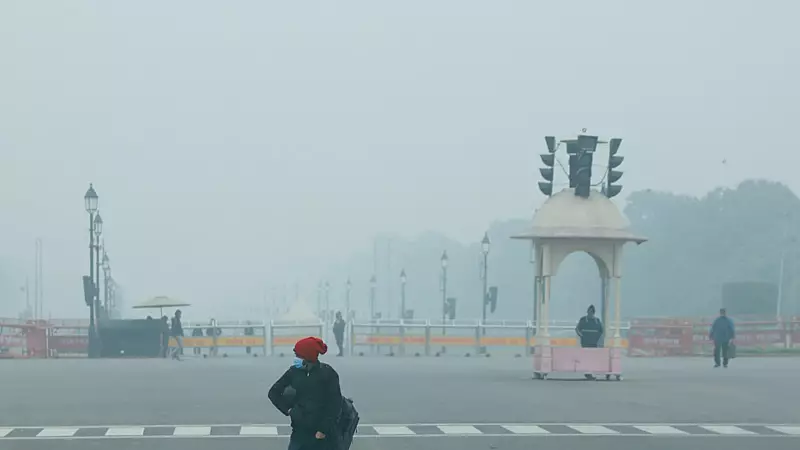
Delhi-NCR residents continue to grapple with hazardous air as the region's air quality remained firmly in the 'Poor' category on Saturday, January 3, 2026. The situation is predicted to worsen in the coming days, according to meteorological forecasts. A significant new analysis highlights a persistent challenge: the majority of the capital's pollution originates beyond its borders.
Worsening Air Quality and Meteorological Warnings
On Saturday, Delhi recorded an average Air Quality Index (AQI) of 276, a notable decline from Friday's reading of 236. The deterioration was mirrored across the National Capital Region. Noida's AQI settled at 242, worse than the previous day's 229. Gurgaon, which had seen a brief respite with a 'Moderate' AQI of 178 on Friday, slipped back to 244.
The India Meteorological Department (IMD) has issued a yellow alert, forecasting moderate to dense fog in the capital on Sunday. This weather pattern is a key contributor to the pollution crisis. Meteorological conditions are currently highly unfavourable for the dispersion of pollutants.

Winds have been calm, predominantly westerly, with speeds often below 15 kmph and dropping drastically at night. The mixing depth—the height at which pollutants can vertically disperse—is expected to shrink from about 1,400 metres to around 1,000 metres by January 6. Furthermore, the ventilation index is likely to remain below the adequate threshold, indicating pollutants will continue to accumulate near the surface.
Consequently, the IMD bulletin forecasts that Delhi's air quality will deteriorate further, likely entering the 'Very Poor' category from Sunday onwards. Shallow to moderate fog during night and morning hours over the next several days will exacerbate the problem.
CREA Report: The Overwhelming Role of Regional Pollution
A critical analysis by the Centre for Research on Energy and Clean Air (CREA) provides crucial insight into the sources of Delhi's toxic air. The non-profit's findings for 2025 are stark: approximately 65% of Delhi's air pollution originated from sources outside the city. These external sources are largely the other NCR districts and neighbouring states.
Local sources within Delhi were responsible for the remaining 35%. This data, particularly from the winter period, confirms that transported pollution consistently outweighs locally generated emissions, underscoring the critical role of regional factors.
Experts cited in the analysis stress that Delhi's geographical position makes it a receptor for polluted air carried by northerly and north-westerly winds. This reinforces the urgent need for coordinated, airshed-level management strategies rather than relying solely on city-specific actions.
Local Contributors and a Silver Lining
Within Delhi's 35% share of local pollution, vehicular emissions emerged as the single largest contributor to PM2.5, accounting for nearly half of the locally generated fine particulate matter. This source outpaces industry, construction, and other combustion activities.
However, the CREA report also notes one positive trend: a significant decline in the contribution of stubble burning. During the 2025 crop-residue-burning period, its average contribution fell to 4.9%, a substantial drop from 15.5% in 2024.
Despite some year-on-year improvement in average PM2.5 and PM10 concentrations during 2025, the report grimly notes that Delhi did not record a single 'good' air quality day throughout the entire year.
As dense fog and stagnant winds set in, the forecast offers little immediate relief. The situation underscores the complex, regional nature of the pollution crisis facing the capital and the necessity for a sustained, multi-jurisdictional response to safeguard public health.