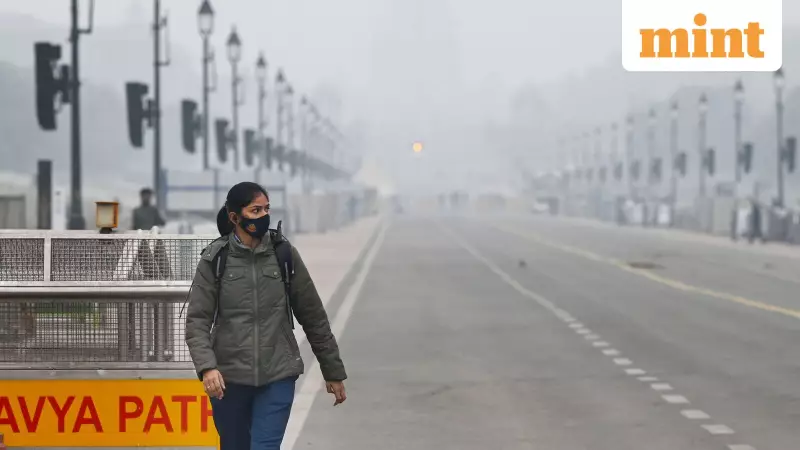
A thick blanket of fog descended upon the national capital on Tuesday morning, significantly reducing visibility and impacting air travel. The India Meteorological Department (IMD) has forecasted that similar foggy conditions are likely to persist over northwest, central, east, and northeast India for the next four to five days.
Visibility Drops, Flight Operations Affected
At 6:00 AM on January 6, the Indira Gandhi International (IGI) Airport in Delhi reported a visibility of just 200 metres with the temperature recorded at 8 degrees Celsius. In response to the low visibility, the airport authorities issued a passenger advisory, stating that flight operations were continuing under CAT III conditions.
This means both arrivals and departures are functional, but passengers should anticipate possible delays and disruptions. Travelers have been advised to contact their respective airlines for the most current flight status updates.

Airlines Issue Travel Advisories Amid Widespread Fog
Major airlines have proactively alerted passengers about potential schedule changes. IndiGo issued an advisory warning that low visibility and fog were affecting not just Delhi, but also several other cities including Amritsar, Bhopal, Chandigarh, Guwahati, Varanasi, Ranchi, and Hindon.
The airline urged passengers to monitor their flight status via the official website or mobile application, assuring them that ground teams were ready to provide full support. The advisory emphasized the airline's commitment to ensuring safe and smooth travel despite the challenging weather.
Temperature and Air Quality Readings
The IMD's forecast for Delhi indicates that the maximum temperature is likely to range between 18 to 20 degrees Celsius, while the minimum is expected to be around 6 to 8 degrees Celsius. The department noted that these temperatures are near normal for this time of the year.
On the air quality front, Delhi residents woke up to 'poor' air. The average Air Quality Index (AQI) reading for the city stood at 286, according to data from the Central Pollution Control Board (CPCB). A closer look reveals a mixed picture across monitoring stations.
19 out of 37 stations reported 'very poor' air quality. However, the Bawana and IGI Airport areas recorded the best readings within the city, with AQI levels of 189 and 180 respectively, which still fall under the 'poor' category. Most other stations also registered AQI values within the 'poor' range.
The combination of dense fog and persistently poor air quality is creating challenging conditions for the city's residents and commuters, with authorities advising caution, especially during the early morning hours.