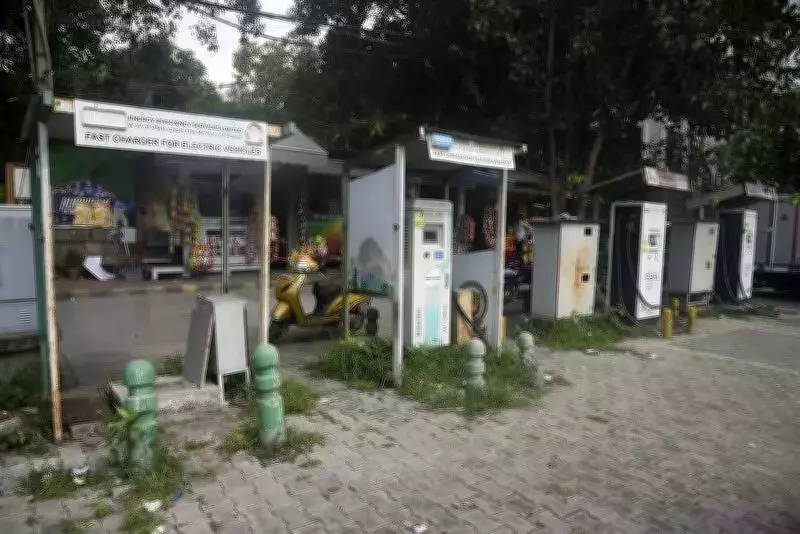
Delhi's Electric Vehicle Charging Infrastructure Faces Critical Shortfall
New Delhi is grappling with a severe deficit in electric vehicle charging infrastructure, with current availability falling dramatically short of requirements. According to recent data, Delhi possesses 8,998 operational EV charging points against a calculated need of 36,177. This leaves a substantial gap of 27,179 charging points, representing a staggering 302% shortfall. In response, the Delhi government has established an ambitious target to elevate the total number to 16,070 by the conclusion of this calendar year.
Neighboring NCR Districts Mirror Delhi's Charging Challenges
The charging infrastructure crisis extends well beyond the national capital's borders into the surrounding National Capital Region. Presently, Gurgaon and Faridabad report a complete absence of public EV charging points, despite requirements for 20 and 26 stations respectively. Noida operates with 69 charging points against a needed 150, while Greater Noida manages with merely three, requiring an additional 13. Ghaziabad, with 126 public charging points, faces a significant deficit of 324 points against its requirement of 450. However, Ghaziabad authorities have outlined plans to augment their network by adding 100 new charging points by December 31st of this year.
Comprehensive Action Plans Target Infrastructure Expansion
As part of coordinated action plans submitted to the Commission for Air Quality Management to combat air pollution, Delhi and NCR cities are collectively targeting the installation of over 7,300 new EV charging points by year's end, with the majority concentrated in Delhi. Of Delhi's existing 8,998 charging points, 8,849 fall under the jurisdiction of the transport department, with the remaining 149 operated by the Delhi Metro Rail Corporation. The city's action plan aims to nearly double the current count to 16,070 within the year, though this will still leave a persistent gap exceeding 20,000 points.

The planned expansion includes significant installations at key transit hubs. Six charging points each are scheduled for the Anand Vihar and New Ashok Nagar RRTS stations, with an additional 66 points earmarked for various Delhi Metro stations. Regarding battery-swapping infrastructure—a critical component for certain EV models—Delhi currently maintains 948 stations against a requirement of 1,606. Authorities have set a target to increase this number to 1,268 by the end of 2026.
Expert Analysis: Beyond Infrastructure to Ecosystem Building
Environmental and transportation experts emphasize that robust EV infrastructure is fundamental to achieving clean mobility in Delhi, but stress that adherence to implementation timelines is crucial. Anumita Roychowdhury, Executive Director of Research and Advocacy at the Centre for Science and Environment, articulated a comprehensive vision. "To realize an ambitious zero-tailpipe-emissions target and substantively improve air quality, the strategy must evolve from merely constructing charging stations to cultivating a cohesive charging ecosystem," she stated.
Roychowdhury highlighted the necessity for an urgent upscaling of the charging network, the development of dedicated charging hubs, and the provision of adequate battery-swapping facilities. She identified the implementation of 'Right to Charge' legislation as particularly critical to prevent obstruction when residents seek to install chargers in their private parking spaces. "It should be mandatory that a substantial portion of all parking spaces in new residential and commercial developments be EV-ready," she added.
Amit Bhatt, India Managing Director of the International Council on Clean Transportation, noted that charging point requirements are fundamentally based on vehicle density. "Beyond the expansion of public charging points, serious consideration must be given to destination charging—whether at home or workplaces," Bhatt explained. He observed that most existing EV charging points were installed during the initial phase of electrification, often in readily available spaces. "Future additions must be strategically placed where demand is highest, and these points require surveillance to prevent vandalism," he advised.

Oversight and Monitoring by Air Quality Commission
A senior official from the Commission for Air Quality Management confirmed that the commission will actively monitor and review the progress of the action plans submitted by Delhi and the NCR cities. Each jurisdiction has established its own individual targets for EV charging infrastructure development as part of the broader strategy to mitigate air pollution and promote sustainable transportation.
The collective push for enhanced EV infrastructure across Delhi and the NCR represents a significant step toward cleaner urban mobility. However, the substantial existing gaps and the challenges of rapid, targeted expansion underscore the complex journey ahead in building a fully functional electric vehicle ecosystem capable of supporting widespread adoption and contributing meaningfully to improved air quality in one of the world's most populous metropolitan regions.