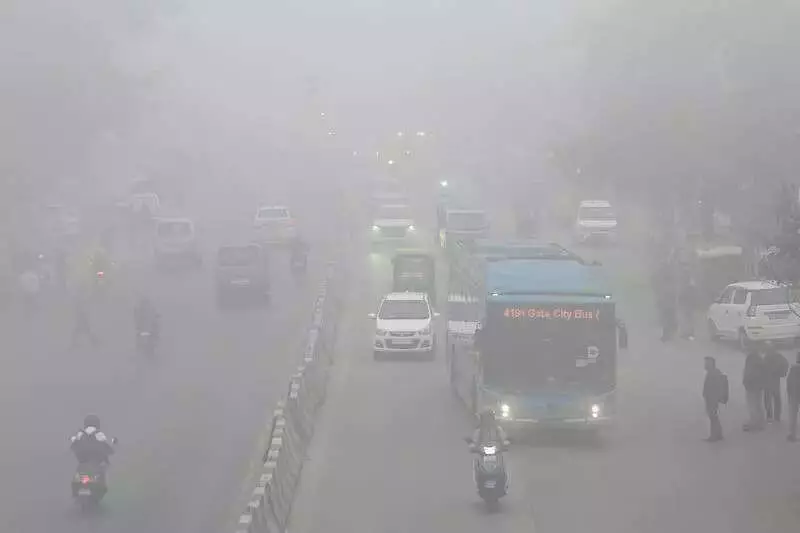
New Delhi greeted the first morning of 2025 with a cool and foggy embrace, offering a slight respite in travel disruptions but continuing its battle with toxic air. While the severe flight cancellations of New Year's Eve eased, the capital remained shrouded in a haze of pollution and moderate fog, keeping temperatures well below the seasonal average.
Transport Relief Amidst Persistent Haze
The dense to very dense fog that had severely impacted the region dissipated slightly due to light winds, bringing much-needed relief to the transport sector. No flights were cancelled on January 1, a stark contrast to the approximately 150 cancellations witnessed on December 31. However, air travel was not completely smooth, with around 500 flights experiencing delays throughout the day.
The blanket of moderate fog prevented direct sunlight from reaching the surface, suppressing daytime temperatures. This fog, combined with the city's chronically high pollution levels, created a thick layer of toxic smog, reducing visibility across the National Capital Region.

Temperature Dip and Air Quality Concerns
The maximum temperature recorded on New Year's Day was 17.3 degrees Celsius, marking a two-degree departure below the normal range. This followed Wednesday's maximum of 14.2 degrees, which was Delhi's lowest daytime temperature since December 29, 2019. The minimum temperature settled at 10.6 degrees Celsius, four degrees above normal. No weather station reported cold day conditions.
The city's air quality remained a significant concern, stubbornly lodged in the higher end of the 'very poor' category. The 24-hour average Air Quality Index (AQI) was recorded at 380 at 4 PM, slightly worse than the 373 noted on Wednesday. Forecasts indicate that the air quality is likely to remain in the 'very poor' bracket for the next several days.
Forecast and Annual Air Quality Review
The India Meteorological Department (IMD) has issued an orange alert for Friday, predicting dense to very dense fog in parts of Delhi. A yellow alert is in place for Saturday, warning of moderate to dense fog. Icy northwesterly winds are expected to gain speed during the day, capping the maximum temperature between 16 and 18 degrees Celsius. Cold day conditions are considered unlikely.
Weather analysts have forecast a sharp drop in the minimum temperature starting January 4. Despite the current poor conditions, Environment Minister Manjinder Singh Sirsa highlighted annual improvements. He stated that Delhi achieved measurable strides in air quality in 2025, citing a reduction in PM2.5 and PM10 levels. The city recorded 79 days with 'good' or 'satisfactory' AQI (below 100) and 200 clean air days, the highest number since 2018. The January to November average AQI stood at 187, the best in eight years, with only eight severe air days, the lowest on record.