Drone Technology Uncovers World's Largest Freshwater Turtle Nesting Colony in Amazon Basin
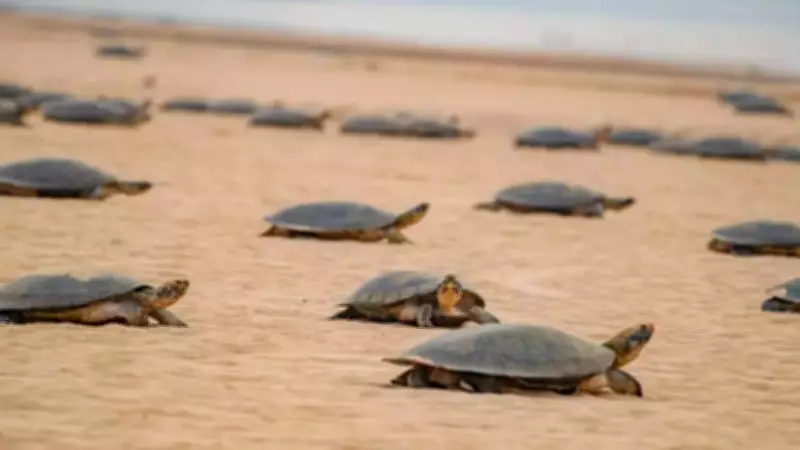
Deep within the vast Amazon rainforest, an extraordinary natural spectacle unfolds annually along the sandy banks of the Guaporé River. Thousands upon thousands of giant turtles emerge from the water in a synchronized display that scientists now believe represents the largest wildlife "maternity ward" ever documented for freshwater species.
Massive Gathering of Giant South American River Turtles
Using advanced drone technology, researchers recently conducted aerial surveys that revealed more than 41,000 giant South American river turtles (Podocnemis expansa) gathering to nest along this critical waterway that forms part of the border between Brazil and Bolivia. This remarkable discovery provides unprecedented insight into the secretive reproductive behaviors of one of the world's largest freshwater turtle species.
The giant South American river turtle is a substantial aquatic reptile, with adults capable of growing nearly 90 centimeters in length and weighing up to 80 kilograms. Each year, typically during July and August, female turtles migrate to specific sandy riverbanks across the Amazon basin to dig nests and deposit their eggs. While this nesting behavior is characteristic of many turtle species, the sheer scale observed along the Guaporé River has astonished the scientific community.

Technological Breakthrough in Wildlife Monitoring
Traditional methods of counting nesting turtles have proven challenging and often inaccurate. Ground-based observers initially estimated approximately 16,000 turtles at this site, but drone technology revealed a dramatically different reality. Researchers from the University of Florida and the Wildlife Conservation Society employed drones to capture thousands of high-resolution images over multiple days, which were then stitched together into detailed orthomosaic maps.
The drone methodology involved marking 1,187 turtles with harmless white paint patches to enable individual identification across multiple images. By tracking these marked turtles and applying sophisticated statistical models, scientists could accurately estimate the true population size while accounting for turtles that appeared in multiple photographs due to their constant movement.
Conservation Significance of the Discovery
This massive nesting colony represents more than just a biological curiosity—it provides crucial data for conservation efforts targeting a species that has faced significant pressures for decades. Throughout the Amazon region, giant South American river turtles have historically been threatened by egg harvesting for food, hunting of adults, and habitat loss due to river changes and development.
The ability to accurately monitor population trends through drone technology enables conservationists to assess the effectiveness of protection measures. A decline in numbers would serve as an early warning signal requiring immediate intervention. This particular nesting site along the Guaporé River may represent one of the species' most vital breeding locations, making its protection essential for long-term survival.
Transforming Wildlife Research Methodology
This discovery exemplifies how modern technology is revolutionizing wildlife research in remote and challenging environments. Drone-based surveys offer several advantages over traditional methods:
- Greater accuracy in population estimates
- Reduced disturbance to nesting animals
- Ability to cover larger areas more efficiently
- Creation of permanent visual records for longitudinal studies
The research demonstrates that even in the digital age, our planet continues to reveal astonishing natural phenomena that challenge previous scientific understanding. As technology advances, researchers gain unprecedented capabilities to document and protect Earth's remarkable biodiversity, particularly in hard-to-access regions like the Amazon basin.