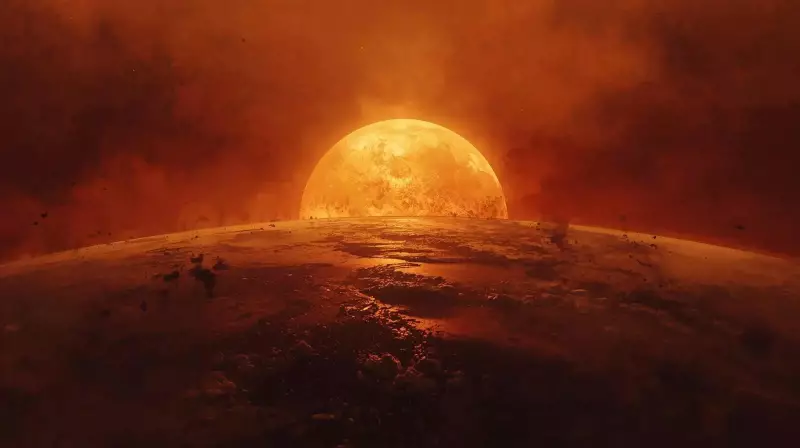
We take it for granted with every breath, but the life-giving oxygen in Earth's atmosphere has an expiration date. A startling new study, supported by NASA and led by researchers from Japan's Toho University and the USA's Georgia Institute of Technology, reveals that our planet's oxygen-rich era is a temporary phase. In roughly a billion years, the air will become hostile to complex life, reverting to a state dominated by microbes that do not need oxygen.
The Sun is the Silent Culprit
The research points to a surprising trigger for this atmospheric collapse: our own Sun. Over hundreds of millions of years, the Sun is slowly getting brighter. This increase in solar energy will accelerate the weathering of silicate rocks on the Earth's surface. As these rocks break down faster, they will pull vast amounts of carbon dioxide (CO2) from the atmosphere.
While reducing this greenhouse gas might seem beneficial initially, it sets off a catastrophic chain reaction. Plants and photosynthetic organisms rely on CO2 to produce oxygen. As CO2 levels plummet, photosynthesis will weaken dramatically. The models, based on over 400,000 simulations, show a tipping point where oxygen production can no longer keep pace. Methane will then build up, and the protective ozone layer will fade, exposing the planet to harsh ultraviolet radiation.

A Return to Earth's Ancient Past
This future represents a full-circle return for our planet. For most of Earth's early history, oxygen was scarce. The Great Oxidation Event, driven by ancient cyanobacteria, gradually filled the skies with oxygen, enabling the evolution of complex life. The new study suggests this oxygen-rich state is not the final chapter.
The research indicates that once oxygen decline begins, it will not be a gentle slide but a rapid collapse. The planet will flip back to conditions resembling its primordial past. Anaerobic life forms—microbes that thrive without oxygen—will once again become the dominant inhabitants. Animals, plants, and all complex creatures will quietly disappear from the Earth, not with a bang, but through the relentless workings of planetary chemistry and deep time.
Why This Billion-Year Forecast Matters Today
A timeline of a billion years is almost incomprehensible—human civilization is a mere blink in comparison. This research does not predict an imminent crisis for humanity. However, it profoundly reshapes our perspective in two key ways.
First, in the search for extraterrestrial life, scientists often treat atmospheric oxygen as the primary biosignature. This work suggests that oxygen-rich windows may be relatively brief in a planet's lifespan. We could potentially miss inhabited worlds simply because they are not in their "oxygen phase" when we observe them.
Closer to home, it serves as a humbling reminder. The air we breathe, which feels eternal and ordinary, is the product of a delicate and dynamic planetary balance. Earth is not a static stage for life but a system in constant flux. The era of oxygen, which allowed beings like us to flourish, is special but ultimately temporary—even if its end lies far beyond any human horizon.