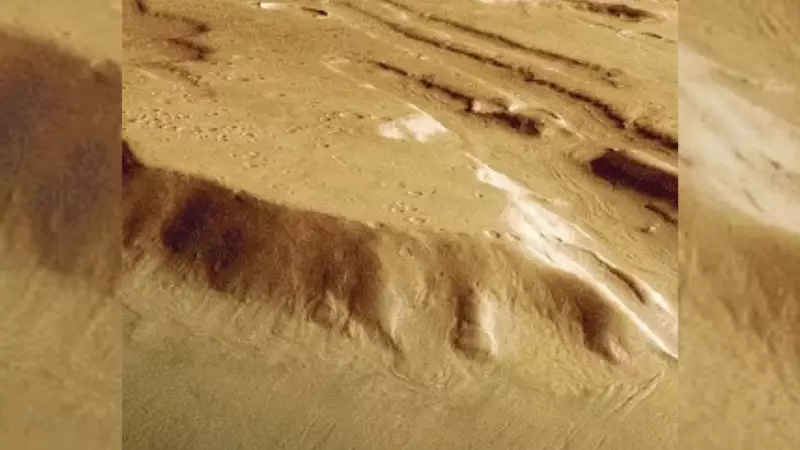
Newly released images from a European spacecraft have provided stunning evidence that Mars experienced a significant ice age in its recent geological past. The findings reveal a planet whose mid-latitude regions were once sculpted by flowing ice, offering a fresh perspective on the climatic history of our neighbouring world.
Frozen Landscapes Etched in Martian Rock
The European Space Agency's (ESA) Mars Express orbiter has captured detailed views of a region known as Coloe Fossae. Located in the northern hemisphere of Mars, this area displays a dramatic and telling landscape. The terrain is marked by long, shallow grooves that stretch across deep valleys, scattered impact craters, and rocky plains. According to a report in Science Daily, these distinctive features are not random; they are the clear fingerprints of a past martian ice age.
Scientists explain that this climatic shift was not caused by modern, human-induced climate change as seen on Earth. Instead, it was driven by the slow, cyclical changes in Mars's orbit and the tilt of its axis over vast timescales. The images show how entire blocks of the martian surface have sunk to form Coloe Fossae, while the surrounding craters—some sharp, some worn down, and others partially buried—tell a story of immense geological time.

The Telltale Signs of Flowing Glaciers
On the floors of valleys and craters, the spacecraft's cameras have identified swirling, grooved textures. These patterns are a dead giveaway for where ice once flowed across the surface, behaving much like glaciers do on Earth today. Planetary geologists refer to these formations as lineated valley fill and concentric crater fill.
They were created when slow-moving mixtures of ice, dust, and rock debris crept across the martian ground. Over time, these glacial flows were buried and preserved. The most compelling fact is the location of this evidence. These glacial patterns are found as far from the martian poles as 39 degrees north latitude. This proves that during a martian ice age, glaciers extended far into the planet's mid-latitudes, a region much warmer and drier today.
A Glimpse into a Recent Icy Epoch
The data suggests that ice may have covered the Coloe Fossae region in a geologically recent timeframe. Evidence points to the possibility that this glaciation occurred as recently as half a million years ago. This offers a rare and valuable window into the dynamic climate cycles of Mars, showing it is a world that has undergone profound environmental changes.
These discoveries are crucial for understanding the full history of water on Mars. They help scientists piece together when and where conditions might have been favourable for life. The findings from Mars Express continue to transform our view of the Red Planet from a static, barren world to one with a complex and active climatic past.