

US F-15E Pilots Evaded Iranian Forces Using Advanced Survival Radio Technology
Immediate survival became the paramount concern for the two US Air Force F-15 Strike Eagle pilots the moment they ejected from their stricken aircraft over hostile territory. Upon hitting the ground deep inside Iran, their intensive Survival, Evasion, Resistance, and Escape (SERE) training instinctively activated, providing a critical mental framework for the perilous situation ahead.
The Critical Challenge: Communication Without Detection
The downed aircrew, comprising both the pilot and the Weapons System Officer (WSO), faced a formidable dual objective. They needed to avoid detection by Iranian military forces and civilians while simultaneously maintaining vital contact with potential rescuers. Standard military doctrine often enforces radio silence to prevent position disclosure, but this complex scenario demanded a delicate balance between communication and concealment.
This precise contingency is why aircrew worldwide undergo rigorous SERE training, preparing them to survive and evade capture hundreds of kilometers behind enemy lines. Both crew members relied heavily on this training, but they possessed an additional technological advantage that proved decisive.

The AN/PRQ-7 Combat Survivor Evader Locator (CSEL): A Technological Lifeline
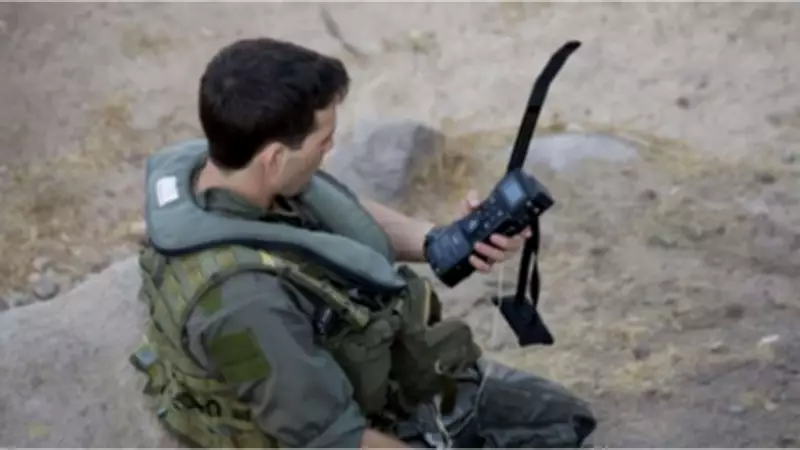
The downed US aircrew were equipped with the AN/PRQ-7 Combat Survivor Evader Locator (CSEL), a handheld survival radio utilized by US and NATO forces. This device provided a secure, two-way, satellite-based communication system, enabling coordination with friendly forces without revealing their location to enemy units equipped with advanced signal detection and jamming capabilities.
The CSEL system transmits user location data through pre-programmed information bursts using both Search And Rescue Satellite (SARSAT) networks and Ultra High Frequency (UHF) radio bands. Crucially, it incorporates Low-Probability-of-Intercept/Detection (LPI/D) design principles, making it exceptionally difficult for adversaries to locate during operation.
Advanced Security Features of the Survival Radio
The handheld device includes several sophisticated security mechanisms. A selective availability and anti-spoofing module ensures an additional layer of protection through encrypted radio messaging. Furthermore, the system contains 23 pre-programmed messages that can be transmitted as encrypted bursts. This method prevents the sender's location from being tracked via traditional radio triangulation techniques, a common threat in hostile signals environments.
The CSEL also functions as a GPS-enabled locator beacon, providing precise coordinates to rescue teams while maintaining operational security. Its dual-communication capability via satellite and UHF offers redundancy, ensuring connectivity even in challenging conditions.
Operational Success and Strategic Implications
The deployment of the AN/PRQ-7 CSEL was instrumental in the successful extraction of both the pilot and WSO in two separate rescue missions. The device not only maintained critical communication links with rescue assets but also effectively provided an "invisibility cloak" under the intense scrutiny of Iran's robust signals intelligence apparatus.
This incident underscores the vital importance of advanced survival technology in modern combat search and rescue (CSAR) operations. The CSEL system exemplifies how technological innovation, when combined with rigorous training, can mean the difference between capture and safe recovery in high-threat environments. The successful evasion and rescue highlight ongoing advancements in personal survival equipment that protect personnel behind enemy lines, reinforcing the "no man left behind" ethos through both training and technology.






