Gurgaon Breathes Easier as Air Quality Turns 'Moderate' After 22 Days
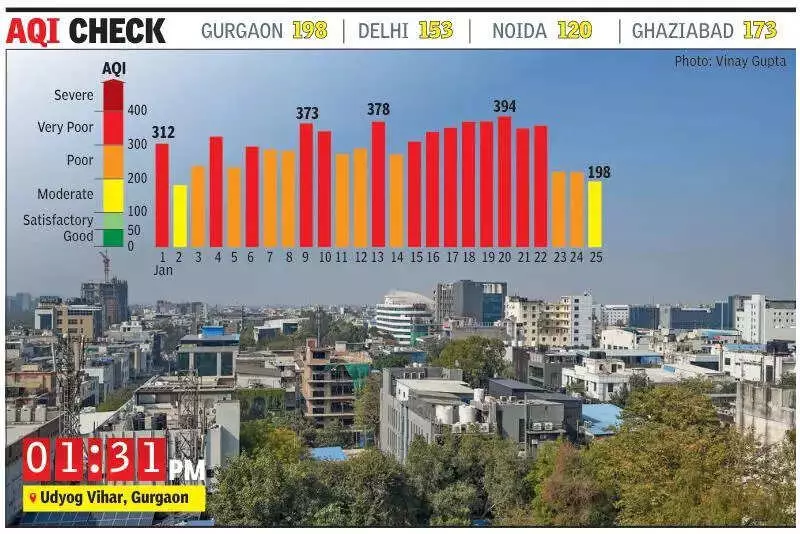
Residents of Gurgaon experienced a welcome respite from hazardous air pollution on Sunday as the city's air quality index (AQI) dropped to 198, placing it in the 'moderate' category for the first time since January 2. This marked a significant improvement after 22 consecutive days of severely polluted air that had plagued the National Capital Region satellite city throughout most of January.
Monitoring Stations Show Varied Readings
According to data released by the Central Pollution Control Board, three of Gurgaon's four active monitoring stations recorded varying AQI levels on Sunday. The readings showed:
- Gwal Pahari recorded the best air quality with an AQI of 151
- Sector 51 stood at 207
- Vikas Sadan reported 227
These numbers represented a dramatic shift from the persistent high pollution levels that had dominated the city's air quality charts throughout January.

January's Pollution Crisis and Temporary Relief
The improvement came after weeks of alarming pollution levels during which Gurgaon frequently fell into the 'very poor' and 'severe' categories. Monthly pollution data revealed that daily PM2.5 levels—the fine particulate matter most dangerous to human health—remained consistently above 300 micrograms per cubic meter for much of the month.
The situation reached its peak between January 18 and January 22 when PM2.5 concentrations approached the 400 mark, creating hazardous breathing conditions for residents and prompting health advisories from authorities.
Weather Conditions Drive Improvement
Environmental officials attributed the temporary air quality improvement to enhanced dispersion conditions over the weekend. Meteorological factors played a crucial role in this change, with clearer skies and stronger northerly winds helping to disperse accumulated pollutants.
The Delhi forecasting system documented specific weather patterns that contributed to the cleaner air:
- Partly cloudy conditions prevailed
- North-west winds reached speeds up to 20 kilometers per hour over the past 24 hours
- A slight decrease in minimum temperatures occurred
- Daytime temperatures showed a marginal rise
This combination of meteorological factors created more favorable conditions for pollutant dispersion, offering residents temporary relief from the toxic air that had become commonplace.
Short-Lived Relief Expected
Despite the current improvement, meteorological agencies have cautioned that this respite may be temporary and short-lived. Forecasts indicate that wind speeds are expected to weaken over the next two days, with shallow morning fog likely to return.
The ventilation index—a measure of the atmosphere's ability to disperse pollutants—is projected to remain below the favorable threshold of 6,000 square meters per second. This suggests that pollution may accumulate more easily in the coming days.
Future Projections and Weather Events
Air quality projections paint a concerning picture for the immediate future. Models suggest that Gurgaon's air quality may slip back into the 'poor' category on January 26 and January 27 before potentially returning to 'moderate' levels on January 28. The broader outlook for the coming week points to air quality fluctuating between 'moderate to poor' levels.
Meteorologists have forecast light rain accompanied by thunderstorms and gusty winds of 30 to 40 kilometers per hour around January 27. While this weather system may bring brief relief by washing away some pollutants, environmental experts note that such weather-related improvements are typically temporary and do not address the underlying causes of air pollution.
The situation highlights the ongoing challenge of managing air quality in urban centers like Gurgaon, where meteorological conditions play a significant role in determining daily pollution levels alongside persistent emission sources.