

Gurgaon Emerges as India's Most Polluted City in March 2026 with Alarming PM2.5 Levels
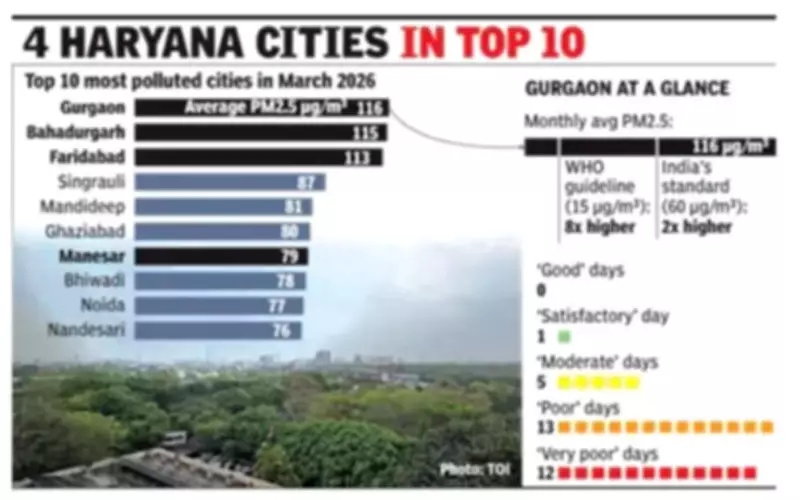
Gurgaon has been ranked as the most polluted city in India for March 2026, according to a recent analysis by the Centre for Research on Energy and Clean Air (CREA). The city recorded a monthly average PM2.5 concentration of 116 µg/m³, which is nearly twice India's national ambient air quality standard of 60 µg/m³ and significantly above the World Health Organization (WHO) guideline of 15 µg/m³.
Widespread Pollution Across Indian Cities
The analysis, which covered 251 cities, revealed that Haryana accounted for four of the top 10 most polluted cities, followed by two each from Madhya Pradesh and Uttar Pradesh, and one each from Rajasthan and Gujarat. Other cities in the top 10 included Bahadurgarh, Faridabad, Singrauli, Mandideep, Ghaziabad, Manesar, Bhiwadi, Noida, and Nandesari.
Gurgaon showed sustained exposure to high pollution levels, appearing 27 times among the top 10 most polluted cities during March—the highest frequency recorded. Throughout the month, air quality remained consistently poor. Of the 31 monitored days, Gurgaon recorded 13 days in the 'poor' category (91–120 µg/m³) and 12 days in the 'very poor' category (121–250 µg/m³) based on PM2.5 levels. Only one day was classified as 'satisfactory,' with none meeting the 'good' standard.

National and State-Level Air Quality Trends
At the national level, 220 out of 251 cities with over 80% data availability from continuous ambient air quality monitoring stations reported PM2.5 levels within India's daily standard. However, only three cities met the stricter WHO guideline, highlighting a significant gap between national standards and global health benchmarks.
Haryana also recorded the highest number of cities exceeding National Ambient Air Quality Standards (NAAQS), with nine out of 24 cities breaching limits, followed by Uttar Pradesh. Among cities under the National Clean Air Programme (NCAP), seven of 96 exceeded India's daily PM2.5 standard, while 94 breached WHO limits. For non-NCAP cities, 154 out of 155 exceeded WHO limits, and 25 crossed national standards.
Progress and Challenges Under NCAP
The CREA analysis assessed progress under the NCAP for the fiscal year 2025–26, based on PM10 reductions against the 2017–18 baseline. It found that 89 of 96 NCAP cities continue to exceed annual NAAQS limits. While 79 cities showed improvement, PM10 levels increased in 14 cities and remained unchanged in three. Notably, 27 cities achieved more than a 40% reduction in PM10 levels.
Among NCAP cities, Ghaziabad recorded the highest annual PM10 concentration at 215 µg/m³, followed by Delhi at 201 µg/m³ and Noida at 195 µg/m³—all exceeding national standards by more than threefold.
State-Level Variations and Expert Insights
State-level trends indicated that Odisha reported the highest number of cities with rising PM10 levels (five), followed by Madhya Pradesh and Andhra Pradesh (two each). In contrast, Uttar Pradesh recorded the highest number of cities with over 40% reduction, followed by Maharashtra and Punjab.
Dehradun recorded the sharpest improvement with a 75% reduction, while Visakhapatnam saw the highest increase at 73%. Delhi recorded a 17% reduction over the same period.
Manoj Kumar, an analyst at CREA, emphasized that many cities remain far from achieving NCAP targets. "Some have even seen rising pollution levels, which is a serious concern. As the programme moves into its next phase, there is an opportunity to base interventions on robust, science-based solutions, with funding directed towards the major pollution sources identified in each region. In recent years, more cities have slipped into non-attainment status, which means that revising NCAP to include emerging hotspots, adopting a regional approach, and enforcing stricter emission standards will all be essential," he said.
Conclusion: Long-Term Improvements vs. Short-Term Spikes
The findings indicate that while some long-term improvements are visible, short-term PM2.5 spikes continue to drive severe pollution episodes, particularly in cities like Gurgaon. The analysis was released by CREA as part of its latest assessment of NCAP progress and monthly air quality trends, underscoring the ongoing challenges in India's fight against air pollution.






