Gurgaon Emerges as Top Laggard in Anti-Smog Gun Deployment Across Haryana
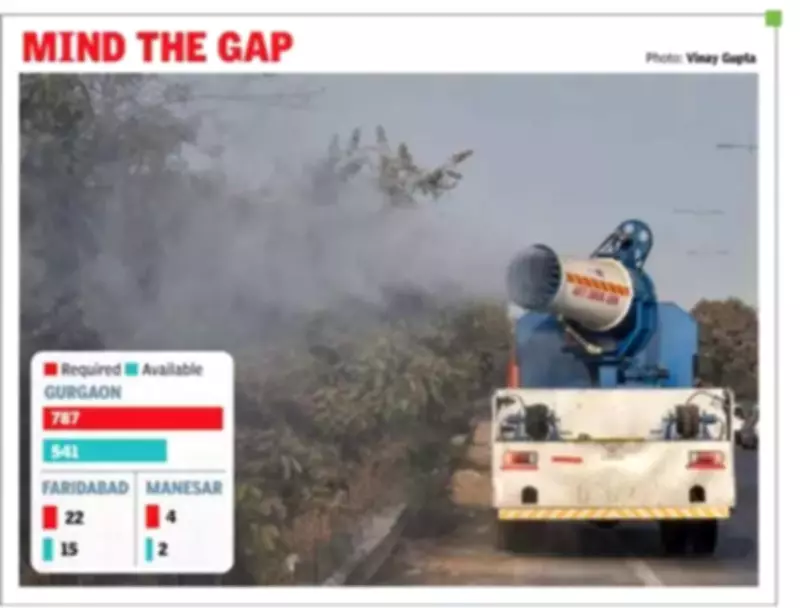
Gurgaon has been identified as the city with the most significant shortfall in anti-smog gun infrastructure within Haryana, according to recent data submitted to the Commission for Air Quality Management (CAQM). The city requires a total of 787 anti-smog guns but currently possesses only 541 units, leaving a substantial gap of 246 devices. This deficiency persists despite repeated winter action plans aimed at combating air pollution in the National Capital Region.
Understanding the Anti-Smog Gun Technology
An anti-smog gun is a cannon-shaped apparatus designed to spray fine water particles into the atmosphere, generating an artificial mist that assists in settling dust, PM2.5 particles, and various other pollutants. The system is connected to a water tank for continuous operation and can be mounted on trucks to cover extensive construction zones effectively.
Detailed Breakdown of Gurgaon's Shortage
In Gurgaon, the deficit of 246 units comprises 235 static guns and 11 mobile units. Presently, 528 static guns are deployed at construction sites larger than 5,000 square meters, adhering to norms set by the Haryana State Pollution Control Board (HSPCB). However, the city still falls considerably short of the mandated requirements. The shortfall in mobile units alone is estimated to cost approximately Rs 6 crore, with officials indicating that funding may be sought from CAQM for these truck-mounted smog guns.

HSPCB Norms for Construction Sites
The HSPCB has established clear guidelines for anti-smog gun installation at construction sites:
- Sites spanning 5,000–10,000 square meters must install at least one anti-smog gun.
- For areas measuring 10,001–15,000 square meters, two such machines are required.
- Projects covering 15,001–20,000 square meters must deploy three anti-smog guns.
- Large construction sites exceeding 20,000 square meters are mandated to install four units.
These regulations aim to reduce dust and particulate emissions, particularly as air pollution in Delhi-NCR intensifies each winter. An HSPCB officer from Gurgaon emphasized, "We will ask those not complying with the norms to follow them. If they fail to do so, penalties will be imposed."
Shortfalls in Other Haryana Cities
Several other cities in Haryana also exhibit significant gaps in anti-smog gun availability:
Faridabad: While all seven required static guns are operational, only eight of the 15 necessary mobile units are available, resulting in a shortfall of seven. The estimated cost to address this gap is Rs 3.85 crore, with funding proposed through the environment protection charge (EPC) fund.
Manesar: No static anti-smog guns are required or available. However, of the four mobile units needed, only two are currently in place, with the remaining two under technical evaluation. The procurement cost is estimated at Rs 0.90 crore, with funds indicated as available.
Sonipat: This city faces shortages in both static and mobile categories. Only one static gun is available against a requirement of three, and five mobile units are missing from a needed six. The total estimated cost to fill these gaps is Rs 2.5 crore, proposed to be funded through CPCB funds, though only Rs 50 lakh is currently accessible.
Rohtak: Rohtak has one static anti-smog gun short, with none available against a requirement of one. Its mobile requirement has been met, with two units already deployed. The cost to bridge the static gap is pegged at Rs 0.45 crore.
Karnal: Both static and mobile anti-smog guns remain unavailable despite a requirement of one each. Tenders have been invited, and officials have indicated that funding support will come from the Central Pollution Control Board (CPCB).

Panipat: This city shows one of the widest gaps relative to its size. All five required static anti-smog guns are missing, with an estimated cost of Rs 0.20 crore. In the mobile category, while two units are available with the municipal corporation, seven required units under HSIIDC are yet to be procured. The total estimated cost for mobile units stands at Rs 3.36 crore, with funding arrangements underway between CPCB, the Panipat municipal corporation, and HSIIDC.
Historical Context and Supreme Court Directives
The deployment of anti-smog guns in Delhi-NCR gained momentum following a November 2019 directive from the Supreme Court of India. The court instructed the central government to install smog towers and anti-smog guns to combat air pollution in the region and mandated the CPCB to participate in the implementation plan. Smog towers, envisioned as large-scale air purifiers, are designed to clean up to 32 million cubic meters of air per day.
The persistent shortfalls across Haryana cities underscore ongoing challenges in meeting air quality management targets, despite regulatory frameworks and judicial interventions aimed at mitigating pollution levels in the region.