

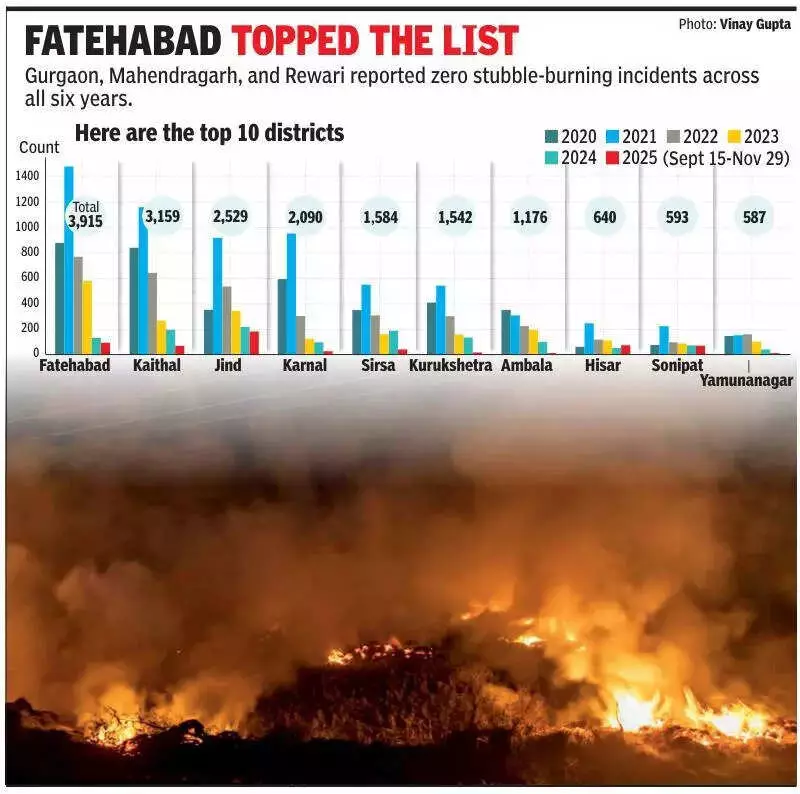
Haryana has marked a significant environmental milestone, concluding its stubble-burning season with the lowest number of farm fire incidents recorded in the past six years. The state witnessed a dramatic 85% reduction from its peak, recording just 659 cases between September 15 and November 29.
District-Wide Transformation in Farm Fire Data
A detailed district-level analysis reveals a steady and impressive decline across most regions. The most significant improvements were seen in districts that were previously the largest contributors to the problem.
Fatehabad and Jind, historically major hotspots, showed consistent declines. Fatehabad reduced its fire count from a high of 1,477 in 2021 to just 88 this season. Similarly, Jind's numbers fell from 915 in 2021 to 180 this year. Sirsa, another major contributor, saw a drastic drop from 549 fires in 2021 to only 37 this season.

Other districts also showcased remarkable progress. Karnal, which logged 955 fires in 2021, ended with just 23 this year. Kurukshetra reported only 11 incidents this season, down from 132 last year. Ambala witnessed only 7 fires, a massive improvement from 97 last year and 346 in 2020.
Minor Increases and Near-Zero Fire Zones
While the overall trend was positive, a few districts experienced a slight uptick. Hisar saw the number of fires rise to 70 this year from 47 in 2023, and Rohtak witnessed an increase from 23 to 53. Sonipat remained nearly unchanged at 67 incidents.
However, these minor increases were overshadowed by the widespread success. Several districts reported minimal or no fires at all. Gurgaon, Rewari, and Mahendragarh recorded zero incidents, while Mewat had just one. Panchkula, which recorded 19 fires last year, ended with only one this season.
The Hidden Factor: Impact of Waterlogging
This year's figures also reflect an unexpected mitigating factor – widespread waterlogging. Large areas of farmland in Jind, Fatehabad, Sirsa, and Kaithal were left uncultivable or experienced delayed harvests, with parts of the crop not surviving.
"This year wasn't normal for us," said Ram Kumar, a farmer from Jind. "The land didn't dry in time, and in many places, the crop just collapsed. People think fewer fires mean everything is fine, but for many of us, it simply means the crop didn't survive."
Officials acknowledge the progress but remain cautious about the future. "We have seen a sustained drop because enforcement and machinery support are finally aligning on the ground," said Darshan Singh of the Haryana agriculture department. "The challenge ahead is to keep farmers equipped so the numbers don't rebound in a normal harvest year."
The data indicates a substantial reduction in the stubble-burning problem, both numerically and geographically. The real test will come next year as Haryana aims to maintain this positive trajectory without the unintended assistance of waterlogged fields.






