Haryana Pollution Board Escalates War on Illegal Factories, Targets Landowners
In a significant policy shift to combat the annual air pollution crisis plaguing Delhi-NCR, the Haryana State Pollution Control Board (HSPCB) has announced that criminal action will now be pursued against both operators of illegal factories and the landowners who lease or sell agricultural plots for such unauthorized industrial activities. Officials confirmed that First Information Reports (FIRs) will be registered against all parties involved wherever industrial operations are discovered on farmland without the necessary statutory approvals.
A Strategic Shift in Enforcement Tactics
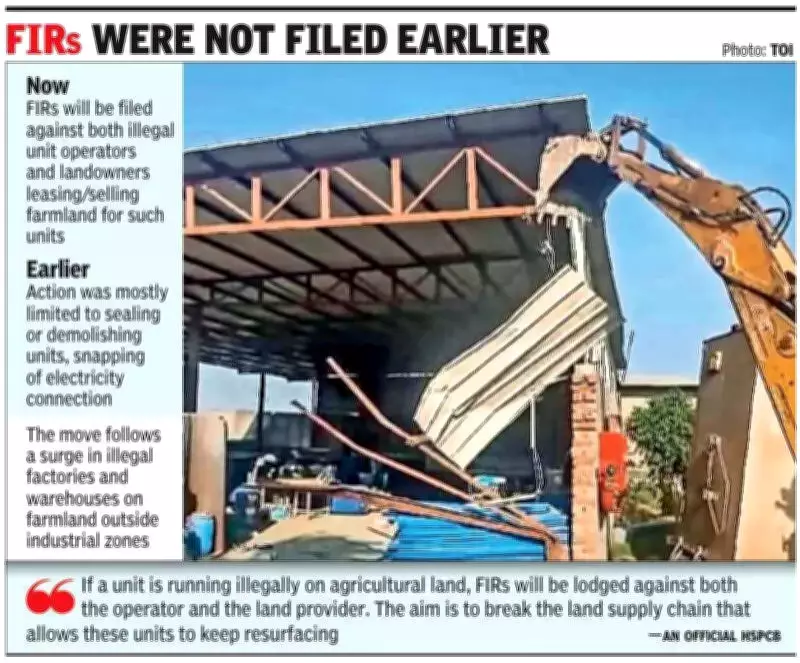
This new directive marks a departure from previous enforcement strategies that primarily focused on sealing or demolishing the illegal units themselves. Senior HSPCB officials have instructed field teams to identify agricultural plots being misused for industrial purposes and to initiate criminal proceedings against the landowners who enable these activities. The core objective is to dismantle the land supply chain that allows these polluting units to persistently resurface in different locations.
An HSPCB official from Gurgaon elaborated, "If a unit is running illegally on agricultural land, FIRs will be lodged against both the operator and the land provider. The aim is to break the land supply chain that allows these units to keep resurfacing." While there have been isolated cases in the past, this represents the first formal, statewide drive explicitly linking enforcement actions to the broader goal of mitigating air pollution.

The Scale of the Problem and Its Environmental Impact
The proliferation of unauthorized factories, warehouses, and recycling sheds beyond designated industrial zones has become a major environmental concern. These facilities typically lack basic pollution control systems. Many operate diesel generators, furnaces, and boilers, which contribute significantly to particulate emissions. During the winter months, these pollutants become trapped at ground level due to atmospheric conditions, exacerbating the region's severe smog.
Environmental officials have identified hotspots where activities like metal processing, plastic recycling, and small-scale fabrication are common. A troubling trend is the operation of many units at night to avoid detection. Recent joint inspections have uncovered hundreds of such units functioning outside approved industrial areas, highlighting the scale of the challenge.
Addressing the Accountability Gap
Enforcement teams have sealed numerous premises and demolished illegal structures in recent weeks. However, officials acknowledged that closures alone have not served as an effective long-term deterrent, as operators frequently simply relocate their operations.
"What this really means is accountability is moving upstream," explained an officer involved in the new drive. "Earlier, operators relocated after raids while landowners remained untouched. Bringing land providers under the FIR framework is expected to reduce repeat violations." This approach seeks to create a more lasting impact by targeting the foundational support—access to land—that these illegal industries rely on.
Coordinated Action and Verification
To ensure effective implementation, the HSPCB is coordinating closely with local revenue officials. Harish Sharma, Regional Officer at HSPCB Ballabhgarh, stated, "Land records of pollution-causing units are being verified to identify the actual owners. FIRs will be registered against them." Tehsildars are assisting in this verification process to flag agricultural plots being misused for industrial purposes.
The pollution board has been directed to intensify its inspection campaigns and share details of non-compliant units with district authorities for coordinated legal action, creating a multi-agency response to the issue.

Activist Response and the Need for Sustained Effort
Environmental activists have welcomed the move but emphasize the critical need for consistent and rigorous follow-through. Narender Sihori, an activist, noted, "For years, illegal units simply shifted from one village to another after raids. Fixing landowner accountability is important, but unless inspections are regular and FIRs are actually taken to their logical end, these factories will keep resurfacing."
This new strategy represents a more holistic attempt to tackle a root cause of industrial pollution in the National Capital Region. By holding landowners criminally liable, authorities hope to create a stronger disincentive and achieve a more sustainable reduction in unauthorized industrial activity, thereby contributing to long-term improvements in air quality.