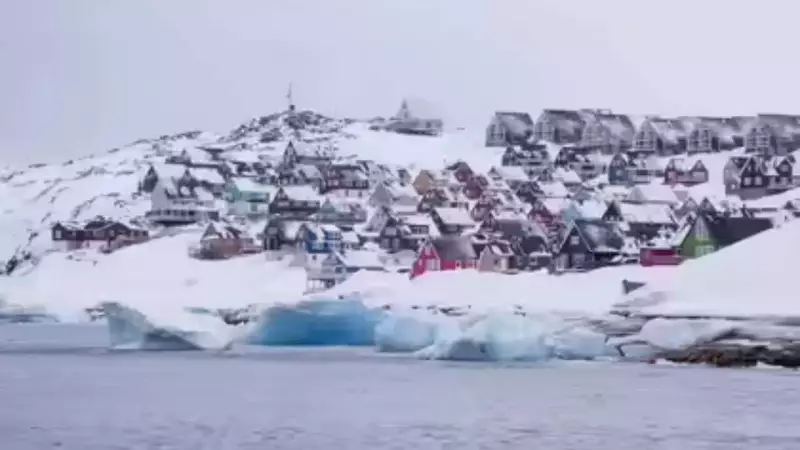
Hidden Sediments Under Greenland Ice Could Accelerate Sea Level Rise
Scientists at the University of California, San Diego made a startling discovery. They found a previously unknown layer beneath Greenland's massive ice sheet. This finding suggests ice could flow toward the ocean much faster than earlier models predicted.
Seismic Waves Reveal a Soft Foundation
Geophysicist Yan Yang led the research team. They used seismic waves generated by earthquakes around the world to map the ground beneath the ice. By measuring how long these waves took to travel, the team could distinguish between hard bedrock and softer, more flexible sediments.
The difference is crucial. Ice behaves very differently depending on what lies underneath it. The study, published in the journal Geology, challenges a long-held belief. It shows subsurface conditions are vital for determining how quickly glaciers slide toward the coast.

"The safety of coastal communities depends on accurate forecasts," Yang stated in a release. "Knowing whether the bed is hard rock or soft sediment is essential for improving future sea-level change predictions."
Why Soft Sediments Speed Up Ice Loss
Ice sheets do not just melt from the top down. They also flow outward under their own immense weight. When ice rests on soft or water-rich sediments, friction decreases dramatically. This allows glaciers to move more rapidly toward the sea.
The research indicates ice movement in parts of Greenland may be controlled more by the ground below than by air temperature alone. Even modest surface warming can trigger changes at the base if meltwater reaches these softer layers.
During warmer periods, meltwater drains through vertical shafts called moulins. This water travels directly to the bottom of the ice sheet. The increased water pressure at the base lowers friction even further, speeding up the flow of ice.
Stable-Looking Regions May Be Vulnerable
One of the study's most significant revelations concerns areas previously considered stable. Satellite images show little surface change in these regions. However, seismic data reveals a different story. Conditions below could allow for rapid movement once certain temperature thresholds are reached.
The subsurface landscape changes over short distances. A glacier sitting on hard rock may behave very differently from another just kilometers away resting on soft sediment. This patchwork foundation complicates predictions. It also helps explain why some glaciers melt quickly when temperatures rise while others take longer.
These hidden sediments could make Greenland's ice "more vulnerable to warming than previously thought."
Improving Models for Future Predictions
The research team emphasizes a critical gap. Current ice sheet models often lack detailed information about basal conditions. Incorporating seismic data could significantly improve predictions of how Greenland will respond to future warming.
Scientists are now working to combine different datasets:
- Seismic data revealing subsurface composition.
- High-resolution bed topography models like BedMachine, which show the land's shape under the ice.
- Ice velocity data gathered from satellites.
Integrating these sources provides a clearer picture of ice movement. It helps identify areas most likely to break down.
Implications Beyond Greenland
While focused on Greenland, the study's findings have global relevance. They apply to other ice-covered regions, including Antarctica. Many ice sheets worldwide rest on complex bases that scientists do not fully understand.
If soft sediments are more common than assumed, global sea level rise estimates may need revision. Better subsurface mapping is essential for both science and practical planning. Coastal development, infrastructure investment, and climate adaptation strategies all rely on accurate sea level forecasts.
Yang and his colleagues conclude that understanding what lies beneath the ice is key to predicting how fast it might disappear.