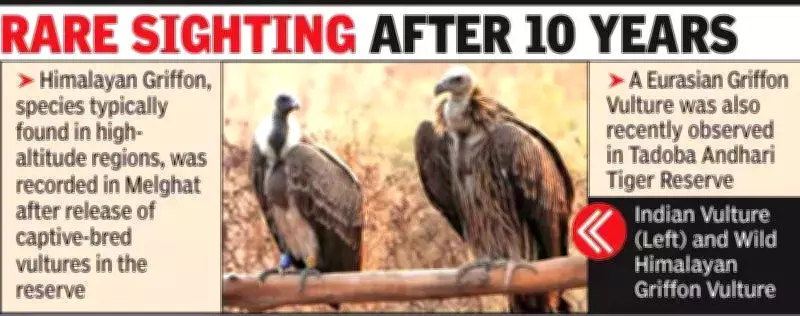
Rare Himalayan Griffon Vulture Sighting in Melghat Signals Conservation Breakthrough
In a significant ecological development, conservation initiatives spearheaded by the Bombay Natural History Society (BNHS) are beginning to show tangible results across Maharashtra. The recent sighting of a wild Himalayan Griffon Vulture within the Melghat Tiger Reserve (MTR) marks the first such observation in ten years. This rare event is being hailed by conservationists as a clear indicator of improving habitat acceptance, directly attributed to ongoing vulture rewilding and release programs.
Ecological Acceptance and Rewilding Success
Bhaskar Das, a conservation biologist at BNHS, emphasized the importance of this development. "The fact that vultures released in Melghat are drawing wild vultures is a big achievement," he stated. "The Himalayan Griffon mixing with captive-released vultures and feeding alongside them indicates growing ecological acceptance of the MTR area. This interaction suggests that the reintroduced birds are successfully reintegrating into the ecosystem and attracting their wild counterparts."
According to BNHS records, the Himalayan Griffon, a species typically inhabiting high-altitude regions and known for seasonal migrations across India, was documented in Melghat following the strategic release of captive-bred vultures into the reserve. This sighting was soon complemented by another significant observation: a Eurasian Griffon Vulture was spotted in the Tadoba Andhari Tiger Reserve. These consecutive discoveries strengthen the evidence that released vultures are effectively re-establishing crucial ecological cues, encouraging wild populations to revisit these habitats.

Historical Context and Population Decline
Vultures had become locally extinct in both Melghat and Tadoba nearly a decade ago, a devastating loss attributed to a sharp population decline across Maharashtra by 2004. The primary cause was the widespread veterinary use of non-steroidal anti-inflammatory drugs (NSAIDs), including:
- Diclofenac
- Aceclofenac
- Ketoprofen
- Nimesulide
These substances proved fatal to vultures, leading to a catastrophic drop in numbers. In response, the Maharashtra state forest department entered into a partnership with BNHS to launch comprehensive vulture revival efforts. These initiatives encompass breeding programs, controlled releases, and meticulous habitat management strategies aimed at restoring these essential scavengers to their natural environments.
Recent Conservation Actions and Future Hopes
As part of the latest phase of this ambitious project, 15 critically endangered long-billed vultures were translocated from the vulture conservation breeding centre at Pinjore to the Somthana range of the Melghat Tiger Reserve on April 23. This translocation represents a proactive step towards bolstering the local vulture population and fostering a sustainable ecosystem.
Kishor Rithe, director of BNHS, reflected on the historical significance of Melghat and expressed optimism for the future. "Melghat has historically been a stronghold for vultures. We hope the birds relearn to thrive in this environment," he remarked. "Their continued presence and proper exploration of the MTR area over the last month shows positive signs. Moreover, their socializing with a wild Himalayan Griffon for almost a week is a remarkable development that underscores the potential for long-term recovery."
The return of the Himalayan Griffon Vulture to Melghat after a decade-long absence is more than just a rare sighting; it is a beacon of hope for conservationists. It demonstrates that concerted efforts in breeding, releasing, and habitat management can reverse the tide of extinction and restore ecological balance. As BNHS and the forest department continue their work, the resurgence of vulture populations in Maharashtra's tiger reserves stands as a testament to the power of dedicated wildlife conservation.