

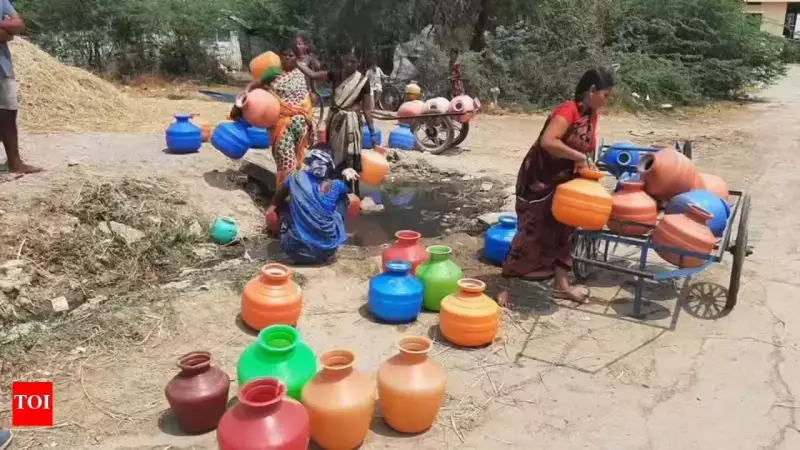
In the narrow lanes of urban India, a daily ritual of quiet desperation unfolds. Men and women wait patiently, rows of plastic drums beside them, their eyes fixed on the alley's bend. The silence shatters as a water tanker reverses in, its engine roar triggering a chaotic scramble. Hundreds of kilometers away, in rural heartlands, women embark on long treks to dried-up wells and shrinking ponds, hoping to find a few precious liters. These contrasting scenes paint a unified, alarming picture: India's water crisis is no longer a distant threat but a daily, grinding reality.
The Stark Numbers: A Nation Under Water Stress
India's challenge is monumental. It supports nearly 17% of the world's population with just 4% of global freshwater resources. According to NITI Aayog's Composite Water Management Index, nearly 600 million Indians experience high to extreme water stress. The situation is deteriorating rapidly. India's per capita water availability was 1,486 cubic metres in 2021, already placing it in the 'water-stressed' category. Government projections warn this could drop to 1,341 cubic metres by 2025 and 1,140 cubic metres by 2050, inching closer to the scarcity threshold of 1,000 cubic metres.
Globally, freshwater reserves are shrinking at an alarming rate, with annual losses estimated at 324 billion cubic metres. India, particularly its northern regions, is a prominent hotspot in this global drying trend, exacerbated by rising temperatures, erratic monsoons, and unsustainable usage.

Groundwater: The Overexploited Lifeline
Groundwater is the invisible backbone of India's water security, supplying 62% of irrigation, 85% of rural water, and 45% of urban water. However, this lifeline is being pumped dry. The Dynamic Ground Water Resource Assessment 2025 reveals India's total annual groundwater recharge is 448.52 billion cubic metres (bcm), with extractable resources at 407.75 bcm. Current extraction has reached 247.22 bcm, pushing the national extraction rate to 60.6%.
The national average masks severe local crises. A staggering 25% of assessment units are classified as Overexploited, Critical, or Semi-Critical. The most vulnerable zones are clear:
- Northwest India (Punjab, Haryana, Delhi, W. Uttar Pradesh): Indiscriminate agricultural withdrawal has led to severe over-extraction.
- Western India (Rajasthan, parts of Gujarat): Arid conditions limit natural recharge.
- Southern Peninsular India (Karnataka, Tamil Nadu, Telangana, Andhra Pradesh): Hard rock aquifers with low storage capacity are under strain.
Punjab's extraction stands at a catastrophic 156.36% of its recharge, with Rajasthan at 147.11%. Delhi, at over 90%, is in the critical category. Cities are on the frontline; 21 major cities including Delhi, Bengaluru, and Chennai risk depleting groundwater. Chennai already faced its 'Day Zero' in 2019.
Root Causes and the Agricultural Paradox
The drivers of the crisis are interconnected. Agriculture consumes 87% of extracted groundwater. Water-intensive crops like paddy in Punjab and sugarcane in Maharashtra drain aquifers. With India's population projected to hit 1.7 billion by 2050 and food demand soaring, this pressure will only multiply.
Other critical factors include rampant pollution (India ranks 120th of 122 nations on water quality), encroachment of urban water bodies, climate change disrupting monsoon patterns, and critically, weak governance. Outdated laws like the Easement Act of 1882 tie groundwater ownership to land, encouraging unchecked extraction, while fragmented management between surface and groundwater authorities hinders cohesive action.
Policy Responses and the Race Against Time
The government has launched several initiatives to combat the crisis. The Jal Shakti Abhiyan (JSA) promotes nationwide water conservation. The Atal Bhujal Yojana focuses on community-led sustainable groundwater management. The Amrit Sarovar initiative aims to develop 50,000 water bodies for local storage. For urban areas, AMRUT 2.0 supports rainwater harvesting and aquifer management.

To improve monitoring, the India Groundwater Resource Estimation System (IN-GRES) provides a public GIS platform for tracking resources. However, experts warn that without behavioral change, crop diversification, and strict regulation, these measures may be insufficient. The parallel, often unregulated tanker economy continues to drain stressed aquifers, accelerating depletion.
The scenes of queues, tankers, and dry wells are a stark warning. India's water crisis is fundamentally a crisis of management. While the nation may not be out of water yet, for millions, time is rapidly running out.





