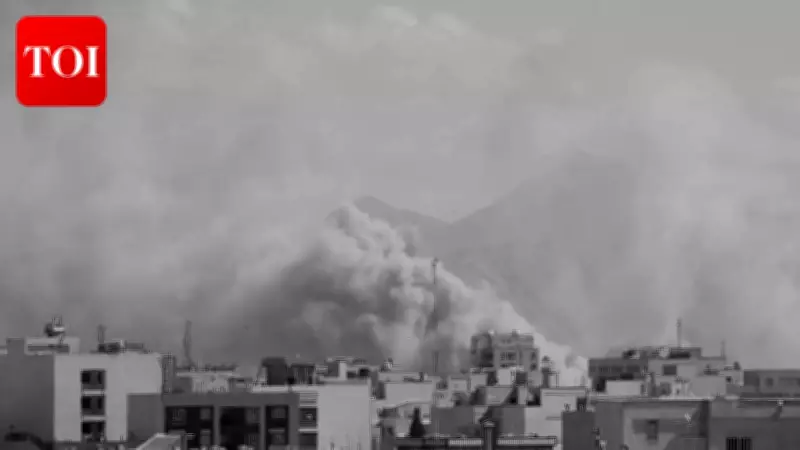
Middle East Erupts in Chaos After US-Israel Strikes Kill Iran's Supreme Leader
The Middle East has been plunged into unprecedented turmoil following devastating joint missile strikes by the United States and Israel on Iran, which resulted in the death of Supreme Leader Ayatollah Ali Khamenei. The attack has triggered immediate retaliatory assaults and widespread instability across the region, with explosions reported in Abu Dhabi, Doha, and at the US navy headquarters in Bahrain.
Indian Citizens Caught in Crossfire: Evacuation Pleas Intensify
The escalating conflict has severely disrupted air travel, forced multiple airport closures, and prompted India to issue urgent advisories urging its citizens in Iran, Israel, and Gulf countries including the UAE to exercise utmost caution. Approximately 3,000 Indian students are currently stranded in Iran, with nearly 2,000 hailing from Jammu and Kashmir alone. About 1,100 to 1,200 remain in active conflict zones.
Nasir Khuehami, National Convenor of the Jammu and Kashmir Students Association, confirmed to ANI that a formal request has been sent to Prime Minister Narendra Modi for immediate evacuation. "Our citizens there, especially Indian students who have studied and worked there for years, are extremely worried. Their families in the Kashmir Valley are frightened and in distress. We have requested the Prime Minister to launch a full-fledged evacuation operation immediately," Khuehami stated.

Student Ordeals: Bomb Sounds Every 15 Minutes
Indian students trapped in Iran have shared harrowing accounts of their experiences. Ayesha, an Indian student stranded in Iran, revealed she was forced to stay to avoid failing exams despite the danger. "We are all cut off from the internet. We hear bomb sounds every 15 minutes. It is very disturbing here. When our embassy gave us the advisory to leave, our university didn't cooperate. They said if you leave, you will fail. Universities and hospitals are closed for 15 days. We are thankful to the embassy but they are also helpless because the airspace is banned," she explained.
Another student in Tehran made an emotional plea: "The situation here feels really bad and uncertain. We don't know what will happen next. We are grateful that the Government of India is discussing our safety, but speed matters. I cannot even speak properly because air strikes are happening. Please get us out of here as soon as possible."
Widespread Stranding: From UAE to Gulf Countries
The crisis extends beyond Iran. In the UAE, over 700 people from Madhya Pradesh, including former MLA and BJP leader Sanjay Shukla, are unable to return due to cancelled flights and temporary airport shutdowns. Shukla shared a video showing smoke from explosions kilometers away and appealed directly to PM Modi for assistance, noting his son is also stranded with him.
Former Depalpur MLA Vishal Patel and numerous other travelers are similarly waiting for the situation to normalize before returning to India, highlighting the widespread impact on Indian citizens across the region.
Government Response and Aviation Chaos
The Ministry of External Affairs has issued urgent advisories and established 24x7 helplines through Indian embassies in Tehran and Tel Aviv. India has officially urged restraint, dialogue, and protection of civilian lives amidst the escalating hostilities.
Aviation disruption has reached critical levels. The Ministry of Civil Aviation reported that 350 flights operated by Indian domestic carriers were cancelled on March 1, 2026 due to airspace restrictions. Passengers are advised to check flight statuses continuously as airlines monitor advisories and reroute or cancel flights as needed.
Additionally, the Ministry of Ports, Shipping, and Waterways has warned Indian seafarers to exercise extreme caution in Iranian waters and nearby regions, with companies instructed to report crew status promptly.
Regional Retaliation and Ongoing Conflict
Iran has launched "Operation Truthful Promise 4," attacking US military bases across the Middle East in retaliation for the strikes that killed Khamenei. The conflict has created a domino effect of violence and instability, with no immediate resolution in sight as diplomatic channels strain under the pressure.

The situation remains fluid and dangerous, with Indian authorities scrambling to coordinate evacuation efforts while navigating complex geopolitical tensions and transportation shutdowns across multiple countries.