

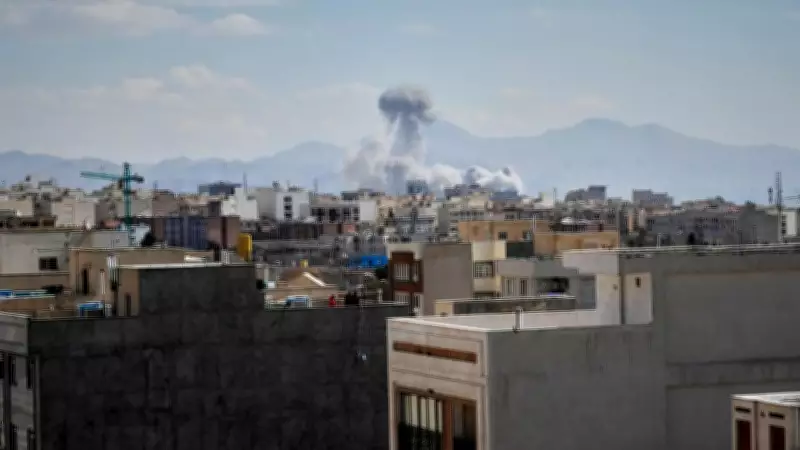
Iran Escalates Regional Conflict with Strikes on Gulf Arab States
In a significant escalation of regional hostilities, Iran expanded its military response on Sunday by targeting Gulf Arab states, including Oman and the United Arab Emirates. This move follows recent US-Israeli strikes and is seen by analysts as an attempt to pressure Washington, though it carries the risk of driving the region into closer alignment with the United States.
Details of the Attacks and Regional Impact
According to reports from CNN, Iran launched a coordinated assault involving missiles and drones aimed at Israel and civilian locations such as hotels and airports across several Middle Eastern countries that host US military bases. Notably, Oman confirmed that its Duqm commercial port was targeted, despite Muscat having mediated talks between the US and Iran just last week. The UAE, particularly its commercial hub Dubai, was also hit, with significant damage reported from missile and drone strikes, as per AP.
Hasan Alhasan, a senior fellow for Middle East policy at the International Institute for Strategic Studies, emphasized the gravity of Iran's actions. "There's a very clear message... that no one is safe, that mediation doesn't offer protection, and that exchanges of mutual assurances or pledges not to allow airspaces or territories to be used militarily against Iran are ineffective either," Alhasan told CNN. He added that Iran's strategy appears designed to increase pressure on Gulf governments, compelling them to push the US administration toward an early end to the conflict.

Potential Counterproductive Outcomes and Gulf States' Response
However, Alhasan cautioned that this approach could backfire. "It's quite clear that the US has a mind of its own, and it's acting in close concert with the Israelis. And I think what Iran's strategy may end up doing, in fact, is pushing the Gulf states into closer alignment with the US, rather than the other way around," he explained. He further noted that while Gulf countries generally favor de-escalation, large-scale civilian casualties might force them to consider more aggressive options.
Anwar Gargash, an adviser to the UAE president and former state minister for foreign affairs, criticized Iran's actions on social media platform X. "Your war is not with your neighbors, and through this escalation, return to your senses, to your surroundings, and deal with your neighbors with reason and responsibility before the circle of isolation and escalation widens," Gargash wrote, indicating that Iran had "missed its target" with these attacks.
Broader Context and Escalating Tensions
These developments mark a dangerous widening of the conflict beyond the direct involvement of the US, Israel, and Iran, placing Gulf states—many of which host critical US military facilities—in a more direct line of fire. This escalation occurs against the backdrop of early Saturday's joint US-Israeli raids in Iran, which resulted in the deaths of Iran's supreme leader Ali Khamenei and top military commanders, further intensifying regional instability.
The situation underscores the complex dynamics at play, with Iran's aggressive posturing potentially undermining its own goals by alienating neighboring states and strengthening US alliances in the region.






